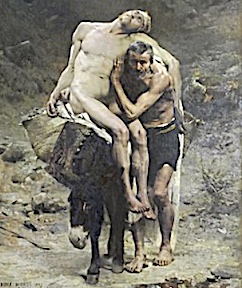
Illustration:The Good Samaritan (1880) by Aimé Morot
Pope Leo’s address to the conference ‘Who is my neighbor today?’
Study beside the Audience Hall – Wednesday, 18 March 2026
Scripture reading Luke 10:25-29
Behold, a lawyer stood up to put him to the test, saying, “Teacher, what shall I do to inherit eternal life?” 26 He said to him, “What is written in the law? How do you read?” 27 And he answered, “You shall love the Lord your God with all your heart, and with all your soul, and with all your strength, and with all your mind; and your neighbor as yourself.” 28 And he said to him, “You have answered right; do this, and you will live.”
29 But he, desiring to justify himself, said to Jesus, “And who is my neighbor?”
Pope Leo’s Address
In the name of the Father, and of the Son, and of the Holy Spirit.
Dear Brothers in the Episcopate,
Distinguished Ministers,
Distinguished Representatives of International and European Institutions,
Dear Brothers and Sisters, good morning and welcome.
You have come from various European countries to Rome to participate in this moment of reflection entitled “Today who is my neighbor?”, organized by the Council of the Bishops’ Conferences of Europe, the World Health Organization (European Region), and the Italian Episcopal Conference.
Today, the second “WHO European Health Equity Status Report” will be presented.
The report highlights the challenges faced by many people in Europe, particularly those experiencing poverty, loneliness, and isolation in their daily lives.
In many countries, inequalities in the field of healthcare are growing, since fewer can access available services..
There must also be urgent attention given to people’s mental health, particularly that of young people, because invisible psychological wounds are no less severe than visible ones.
Health should not be a luxury reserved for the few.
Rather, it is a prerequisite for social peace.
Universal health coverage is not just a technical goal; it is a moral imperative for Just societies.
Therefore, healthcare must be accessible to the most vulnerable not only because their dignity requires it but also to prevent injustice from becoming a cause of conflict.
The challenge at the heart of the Gospel of Luke passage you are reflecting on confronts all of us.
Rather than justifying ourselves, as the lawyer does, we must allow ourselves to be fully examined.
This question is always relevant and has no single, unambiguous answer. Rather, it requires each of us to respond concretely and promptly.
Therefore, we should ask ourselves, “Who is my neighbor at this moment in my life?”
The answers will vary depending on the situation.
What does not change, however, is the call to reach out to others, especially those who are suffering.
In the Book of Genesis we find a similar question: “The Lord said to Cain, ‘Where is Abel, your brother?’ He replied, ‘I do not know; am I my brother’s keeper?’” (Genesis 4:9).
The parable of the Good Samaritan provides the answer: Yes, you are your brother’s keeper because you are called to safeguard his humanity.
St. Augustine tells us that “God himself, our Lord, desired to be called our neighbor. For our Lord Jesus Christ points to himself under the figure of the man who brought aid to the one who was lying half dead on the road, wounded and abandoned by the robbers.”.
In his encyclical Fratelli Tutti, Pope Francis reflected on the role of the robbers who wounded the traveler.
He reminded us that “‘Robbers’ often find secret allies in those who ‘pass by and look the other way”.
Distance, distraction and desensitization to the sight of violence and the suffering of others lead us toward indifference.
Yet all people, especially Christians, are called to focus on those who suffer,
on the pain of the lonely and on those who for various reasons are marginalized and considered “outcasts.”
For without them, we cannot build just societies founded on the human person.
It is an illusiob to think that we can attain happiness by ignoring our brothers and sisters.
Only by working together can we build communities capable of caring for everyone, where well-being and peace can flourish for the benefit of all.
Caring for others’ humanity helps us live our own lives to the fullest.
Dear brothers and sisters,
The Church “has a public role over and above her charitable and educational activities,” yet she is always at the service of “the advancement of humanity and of universal fraternity.”
In cooperation with international organizations, the Churches in Europe and throughout the world, can still play a decisive role in combating healthcare inequalities, particularly in supportinig the most vulnerable populations.
Therefore, I renew my hope – indeed I urgently appeal – that “our Christian lifestyle will always reflect this fraternal, ‘Samaritan’ spirit – one that is welcoming, courageous, committed and supportive, rooted in our union with God and our faith in Jesus Christ.”
Dear friends, I thank you for all that you are doing!
I entrust you to the maternal intercession of the Blessed Virgin Mary, and I cordially invoke God’s blessing upon you, your families and your service.
I thank you and wish you well for your work.