Pope Leo’s message to the Pontifical Academy of Social Sciences
[14-16 April 2026]
“Wisdom enables us to discern and pursue the true and the good”
This year’s theme selection
“The Uses of Power: Legitimacy, Democracy and the Rewriting of the International Order.”
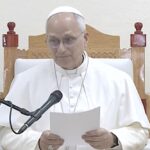
Pope Leo’s message,
I was pleased to learn that the plenary session of the Pontifical Academy of Social Sciences takes place from 14 to 16 April 2026, and I send prayerful good wishes to all taking part.
I express my gratitude to Cardinal Peter Turkson for his dedicated service as Chancellor of the Academy. I likewise thank your President, Sister Helen Alford, for selecting the theme: “The Uses of Power: Legitimacy, Democracy and the Rewriting of the International Order.”
This topic is particularly timely, as it focuses our reflection on the exercise of power, a critical element for building peace within and among nations during this time of profound global change.
According to Catholic social teaching, power is not an end in itself, but rather a means to the common good. Thus, the legitimacy of authority depends on the wisdom and virtue with which it is exercised, rather than on the accumulation of economic or technological strength.
Wisdom enables us to discern and pursue true goods rather than apparent ones and vainglory amid the circumstances of daily life.
This wisdom is inseparable from moral virtues, which strengthen our desire to promote the common good. Justice and fortitude, in particular, are indispensable for sound decision-making and putting decisions into practice.
Temperance is essential for the legitimate use of authority because true temperance restrains inordinate self-exaltation and prevents the abuse of power.
This understanding of legitimate power is best expressed in authentic democracy.
Democracy is more than just a procedure; it recognizes the dignity of every person and calls each citizen to participate responsibly in the pursuit of the common good.
St. John Paul II reflected this conviction when he affirmed that the Church values democracy because it ensures participation in political choices and “the possibility both of electing and holding accountable those who govern, and of replacing them through peaceful means when appropriate” (Centesimus Annus, 46). However, democracy remains healthy only when it is rooted in moral law and a true vision of the human person.
Without this foundation, democracy risks becoming a majoritarian tyranny or a mask for the dominance of economic and technological elites.
The same principles that guide the exercise of authority within nations must also inform the international order.
This is an important truth to recall at a time when strategic rivalries and shifting alliances are reshaping global relations.
A just and stable international order cannot emerge from the mere balance of power or a technocratic logic alone.
Concentrating technological, economic, and military power in the hands of a few threatens democratic participation among peoples and international concord
In this regard, my predecessors have expressed the need for updated institutions and a universal marked by the principle of subsidiarity.
Developing such a global community of fraternity requires “a better kind of politics, one truly at the service of the common good” (Francis, Fratelli Tutti, 154).
Indeed, it is “more necessary than ever to boldly rethink the modalities of international cooperation” (Visit to the FAO Headquarters on the Occasion of World Food Day, October 16, 2025, 7).
Ultimately, when earthly powers threaten we must find hope in the Kingdom of God.
Though not of this world, the Kingdom of God sheds light on earthly affairs and reveals their eschatological meaning.
From this faith-based perspective, we are reminded that God’s omnipotence is especially evident in mercy and forgiveness.
Divine power heals and restores, rather than dominating.
This logic of charity must animate history because human activity inspired by charity helps shape the “earthly city” in unity and peace.
This renders the “earthly city” an imperfect anticipation and prefiguration of the “City of God.”
Such faith strengthens our resolve to build a culture of reconciliation that can overcome the pitfalls of indifference and powerlessness.
I earnestly hope that your reflections during these days will yield valuable insights into the legitimate uses of power, the criteria of authentic democracy, and the kind of international order that serves the common good.
In this way, your work will meaningfully contribute to building a global culture of reconciliation and peace—a peace that is not merely the fragile absence of conflict but the fruit of justice, born of authority humbly placed at the service of every human being and the entire human family.
May the Holy Spirit, the source of all charity, unity, and peace, enlighten your minds and sustain your efforts. I willingly invoke God’s abundant blessings upon all of you.
From the Vatican, 1 April 2026. LEO PP. XIV