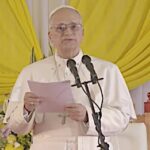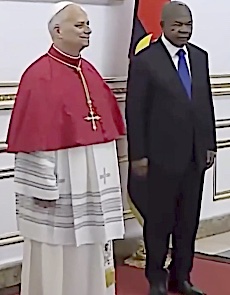
Pope Leo’s address at meeting with Angola authorities,
representatives of civil society and the diplomatic corps
Luanda, Presidential Palace – Saturday, April 18, 2026
Mr. President, Dear Representatives of the Authorities and Members of the Diplomatic Corps, Ladies and Gentlemen,
Mr. President, it is a great joy for me to be among you.
Mr. President, thank you for the invitation to visit Angola and for your kind welcome.
I come to meet your people as a pilgrim searching for evidence of God’s presence in this beloved land.
Before I continue, I would like to assure you of my prayers for the victims of the heavy rainfall and floods that hit the province of Benguela.
I also want to express my solidarity with those who lost their homes.
I know that you, Angolans, are united in great solidarity with the victims and I wish to meet you in the spirit of peace.
I want to acknowledge that your people possess treasures that cannot be sold or plundered.
This joy cannot be extinguished by the most difficult of circumstances.
This joy knows pain, indignation, disappointment, and failure, yet it continues and is reborn among those who have kept their hearts and minds free from the illusion of wealth.
You know very well that your regions are often viewed as a source of something to be given or, more often, taken.
We must break this chain of interests that reduces reality and life itself to an exchangeable commodity.
I would not hesitate to call the joy and hope that Africa provides to the rest of the world “political virtues.”
The young and poor people who live there still dream and hope.
They are not content with what already exists.
They want to rise up and take on great responsibilities.
They make personal commitments.
No ideology can extinguish the wisdom of a nation, and the desire for infinity in the human heart is a deeper principle of social change than any political or cultural program.
I am here among you to serve the best energies that enliven the individuals and communities that create Angola’s colorful mosaic.
I want to listen to and encourage those who have chosen goodness, justice, peace, tolerance, and reconciliation.
At the same time, together with the millions of men and women of goodwill who are this country’s greatest asset, I intend to call for the conversion of those who choose different paths and hinder its harmonious and fraternal development.
Dear friends,
I have mentioned the material riches that powerful interest groups are reaching for, including in your country.
This logic of exploitation brings so much suffering, death, and social and environmental catastrophe!
We can already see how it fuels a discriminatory and exclusionary model of development at every latitude, yet it still tries to impose itself as the only possible model.
Sixty years ago, St. Pope Paul VI aptly interpreted the anxieties of the younger generation and denounced “the aging and already quite rotten face of a commercial and hedonistic culture that nevertheless tries to present itself as the creator of future prosperity.”
He noted: “Therefore, many young people, as if in a natural reflex, unmask this deception, although sometimes in an exaggerated way. It has a certain meaning. Today’s generation of young people expects something different!” (Exhortation Gaudete et Exsultate, VI).
Through the ancient wisdom that feeds your thinking and feeling, you are witnesses that creation is harmony in the richness of diversity.
Your people have suffered every time this harmony has been disturbed by violence.
They bear the scars of material exploitation and the imposition of one idea over others.
Africa urgently needs to overcome the conflicts and hostilities tearing apart the social and political fabric of many countries and fueling poverty and exclusion.
Life blossoms only in encounter. Dialogue is the norm. This does not exclude opposition, which may escalate into conflict.
My venerable predecessor, Pope Francis, offered an unforgettable interpretation of this reality.
He noted, “In the face of conflict, some people simply move on as if nothing had happened.
They wash their hands of it in order to continue their lives.
Others enter the conflict in such a way that they become its prisoners.
They lose their horizons and shift their confusion and discontent onto institutions, making unity impossible.”
However, there is a more effective way to face conflict: accept it, resolve it, and transform it into a new beginning.
‘Blessed are the peacemakers’ (Matthew 5:9)” (Evangelii Gaudium, 227).
Angola can develop greatly if those in power believe in the diversity of the country’s wealth.
Do not be afraid of opposition.
Do not extinguish the visions of the young or the dreams of the elderly. Know how to manage conflicts and transform them into paths of renewal.
Prioritize the common good over the particular good and never identify your own side with the whole. History will then be on your side, even if someone is hostile to you at the moment.
I spoke about the joy and hope that define your young society.
These feelings are usually considered personal and private. However, these feelings are an intense and expansive force that resists resignation and the temptation to withdraw.
Despots and tyrants of body and spirit seek to render souls passive and passions sad.
They want to make us idle, submissive, and subordinate to authority.
When we are sad, we are at the mercy of our fears and nightmares.
We seek refuge in fanaticism, submission, media noise, the mirage of gold, or the myth of identity.
Discontent and a sense of powerlessness and uprootedness divide us instead of uniting us.
This creates a climate of indifference to public affairs, contempt for the misfortune of others, and denial of fraternity.
This dissonance breaks down the fundamental relationships we have with ourselves, with others, and with reality.
As Pope Francis also noted: “The best way to reign and move forward without limits is to sow despair and arouse constant mistrust, even if it is camouflaged under the guise of defending certain values. hyperbole, extremism and polarization have become political tools“ – Fratelli tutti, 15).
True joy frees us from alienation, a concept that faith recognizes as a gift of the Holy Spirit.
And, as St. Paul wrote, “the fruit of the Spirit is love, joy, peace” (Galatians 5:22).
Joy enhances life, pushing us toward social interaction.
Everyone rejoices by developing their cognitive abilities in the knowledge that they are contributing to the common good, and by being recognized as unique and worthy individuals within a community of encounters that expand the spirit.
Joy can forge paths even through the darkest regions of stagnation and anguish.
So let us examine our hearts, dear ones, because without joy, there is no renewal. Without the interior life, there is no liberation. Without encountering others, there is no politics. Without another human being, there is no justice.
Together, you can make Angola a project of hope.
The Catholic Church, whose work for the country, as I know you value so much, wants to be the leaven in the dough and to promote the development of a just model of coexistence, free from the slavery imposed by the elites with large financial resources and false joys.
Only together will we be able to multiply the talents of this great nation, to the urban peripheries and the most remote rural regions, where its life is teeming and its future is being prepared.
Let us remove the obstacles to integral human development, struggling and cherishing hope together with those whom the world has rejected but whom God has chosen.
In fact, this is how our hope was born: “The stone rejected by the builders became the cornerstone” (Ps 118:22) – Jesus Christ, the fullness of man and of history.
God bless Angola!
Thank you.