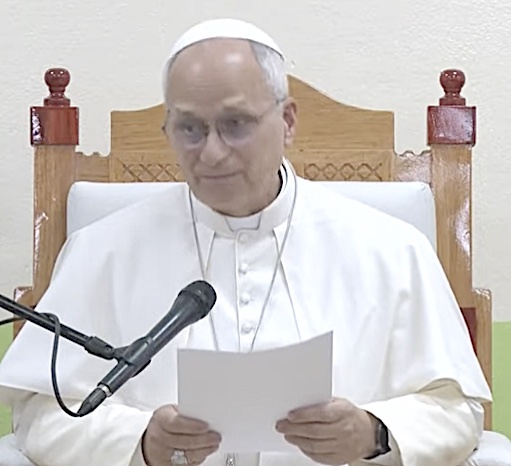
Pope Leo’s address to a meeting with the authorities, civil society and the diplomatic corps
Presidential Palace (Yaoundé), Cameroon — Wednesday, 15 April 2026
“In international relations there is a commandment: Love your neighbor as yourself!”
Mr President,
Distinguished Authorities,
Members of the Diplomatic Corps,
Ladies and Gentlemen,
Thank you very much for the warm welcome and kind words.
I am filled with deep joy to be in Cameroon, often called “Africa in miniature” because of the richness of its territories, cultures, languages, and traditions.
This diversity is not a weakness; it is a treasure.
It promises fraternity and provides a solid foundation for lasting peace.
As a pastor and servant of dialogue, fraternity, and peace, I come to you.
My visit expresses the love of the Successor of Peter for all Cameroonians, as well as his desire to encourage everyone to continue building the common good with enthusiasm and perseverance.
We live in a time when resignation is rampant, and the feeling of powerlessness threatens to paralyze the renewal that nations so desperately need.
The hunger and thirst for justice are great!
How great is the desire for participation, vision, courageous choices, and peace!
I ardently desire to reach the hearts of all, especially young people, who are called to shape a more just world, even on the political level.
I also wish to strengthen the ties of cooperation between the Holy See and the Republic of Cameroon, founded on mutual respect, the dignity of every human person, and religious freedom.
Cameroon remembers the visits of my predecessors: St. John Paul II, a herald of hope for all the peoples of Africa, and Benedict XVI, who emphasized the importance of reconciliation, justice, and peace, as well as the moral responsibility of those in power.
I know these events have left an indelible mark on your national history, calling for a spirit of service, unity, and justice.
So, we must ask ourselves: What stage are we at?
How has the Word preached to us borne fruit? What else remains to be done?
One thousand six hundred years ago, St. Augustine wrote some very timely words: “Even those who command serve those whom they supposedly command. They command not out of a desire to dominate, but out of a sense of duty to protect; not out of pride in their authority, but out of compassion to help their neighbors.” (De civitate Dei X, 14)
From this perspective, serving one’s country means devoting oneself to the common good of the entire nation with clear thinking and a pure conscience: the majority, the minority, and their mutual harmony.
Like many other countries, your country is currently facing difficult challenges.
The tensions and violence affecting some regions of the northwest, southwest, and far north have caused great suffering, including loss of life, displacement of families, and denial of educational opportunities for children, as well as a lack of future prospects for young people.
Behind the statistics are faces, stories, and shattered dreams. In light of these dramatic situations, at the beginning of this year, I urged humanity to reject the logic of violence and war and embrace a peace based on love and justice.
I called for a peace that is unarmed—not based on fear, threats, or armaments—and disarming, capable of resolving conflicts, opening hearts, and building trust, empathy, and hope.
Peace cannot be reduced to a slogan; it must be embodied in a personal and institutional lifestyle that rejects all forms of violence.
That is why I strongly emphasize: “The world desires peace. Enough of wars and their painful piles of corpses, destruction, and exile!”
This call is an invitation to contribute to true peace, which must be placed above all particular interests.
In fact, peace is not established by decree; it must be accepted and lived.
It is a gift from God that grows through patient, shared work.
It is everyone’s responsibility, especially the civil authorities.
To govern means to love your country as well as neighboring countries.
In international relations, there is also a commandment: Love your neighbor as yourself!
To govern means truly listening to citizens and appreciating their intelligence and ability to contribute to lasting solutions.
Pope Francis pointed out the need to overcome the conception of social policy as a policy for the poor, but never with or for the poor.
In this change of approach, civil society should be recognized as the lifeblood of national unity.
Cameroon is ready for this step!
Associations, women’s organizations, youth organizations, trade unions, humanitarian NGOs, and traditional and religious leaders all play irreplaceable roles in building social peace.
They are the first to intervene when tensions arise, accompany the displaced, support victims, open spaces for dialogue, and encourage local mediation.
Their proximity to the territory enables us to grasp the underlying causes of conflicts and find suitable solutions.
Civil society also contributes to forming consciences and promoting a culture of dialogue and respect for differences.
Therefore, the future less exposed to uncertainty is prepared within it.
I would like to highlight the important role of women.
Unfortunately, they are often the first victims of prejudice and violence, yet they remain tireless peacemakers.
Their commitment to education, mediation, and rebuilding the social fabric is unparalleled.
It provides a brake on corruption and abuse of power.
For this reason, too, their voice must also be fully considered in decision-making processes.
Such generous dedication within society makes transparency in the management of public resources and respect for the rule of law essential to restoring trust.
It is time for an examination of conscience and a bold leap forward.
Fair and credible institutions become pillars of stability.
Public authorities must be bridges, not divisive factors, even in times of uncertainty.
Security is a priority, but it must always be ensured with respect for human rights. This requires a balance of discipline and generosity, with a particular focus on the most vulnerable.
True peace is born when everyone feels protected, heard, and respected, and when the law acts as a safeguard against the arbitrary actions of the wealthy and powerful.
Brothers and sisters, if you look closely, you will see that the high positions you hold require a double witness.
The first is realized through the collaboration of the different state administrative bodies and levels in service to the people, especially the poorest. The second is realized by aligning your institutional and professional responsibilities with righteous conduct.
To strengthen peace and justice, we must break the shackles of corruption that pervert power and deprive it of its authority.
Free your hearts from the desire for profit, which is idolatry. True gain is the integral development of the human person—that is, balanced growth in all aspects that make life on this earth a blessing.
Cameroon possesses the necessary human, cultural, and spiritual riches to overcome difficulties and conflicts, and to move towards a stable and prosperous future for all.
A shared commitment to dialogue, justice, and integral development can transform past wounds into sources of renewal.
As I have already mentioned, young people are the hope of the country and the Church.
Their energy and creativity are invaluable assets.
However, when unemployment and exclusion persist, frustration can breed violence.
Therefore, investing in the education, training, and entrepreneurship of young people is a strategic choice for peace.
It is the only way to prevent great talent from leaving the country for other regions of the world.
It is also the only way to combat the scourges of drug addiction, prostitution, and apathy, which are devastating too many young lives..
Thankfully, young Cameroonians have a deep spirituality that resists the unifying power of the market.
This energy makes their dreams precious and gives them roots in prophecy. It nourishes their prayers and hearts.
Religious traditions inspire prophets of peace, justice, forgiveness, and solidarity as long as they are not distorted by fundamentalism.
Through interreligious dialogue and the involvement of religious leaders in mediation and reconciliation initiatives, politics and diplomacy can leverage moral forces to de-escalate tensions, prevent radicalization, and foster a culture of mutual respect and recognition.
Through its educational, health, and charitable activities, the Catholic Church in Cameroon wishes to continue serving all citizens without exception.
It intends to cooperate loyally with civil authorities and all vital forces of the nation to promote human dignity and reconciliation.
Where possible, the Church intends to facilitate cooperation with other countries and strengthen ties between Cameroonians around the world and their communities.
May God bless Cameroon, sustain its leaders, inspire civil society, and enlighten the work of the diplomatic corps.
May he grant the entire Cameroonian people—Christians and non-Christians alike, as well as political and civic leaders—the grace to welcome the Kingdom of God and build a future of justice and peace together.