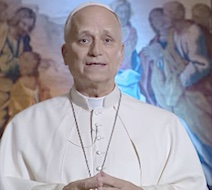
Pope Leo’s Video Message to the International Meeting ‘Unarmed and Disarming Peace’
at Assisi- 27 October 2026
“War can never be waged in the name of God”
Pope Leo’s Video Message
Dear brothers and sisters,
Forty years after the World Day of Prayer for Peace, which took place on October 27, 1986, you have gathered in Assisi.
That event was initiated by St. Pope John Paul II, who emphasized the intrinsic bond between a genuine religious attitude and a keen sense of peace on that occasion.
I extend my warm greetings to the patriarchs and religious leaders who have actively participated in the days of prayer and dialogue held over the years.
I also warmly greet His Excellency, Bishop Felice Accrocca of Assisi; the Franciscan families; and all those in attendance.
I would have very much liked to be with you at the tomb of St. Francis on this important anniversary to see your faces and bear witness together to the fact that living as brothers and sisters is possible!
I thank the Dicastery for Interreligious Dialogue and the Community of Sant’Egidio for their commitment to continuing along the path laid out by my predecessors.
I am heartened by the long and faithful journey undertaken over these years, which has yielded abundant fruit.
Regarding that unforgettable day in October 1986, Pope Francis said:
“It should not and could not have remained an isolated event.
You have continued on this path and have increased its momentum”
Following that historic meeting, St Pope John Paul II called for us to “continue to live the spirit of Assisi” (Address to Leaders of the World Religions in Assisi, October 26, 1986).
This was during the Cold War, a time that was very different from today.
After 1989, many believed that globalization would ensure lasting peace.
However, as I wrote in Magnifica Humanitas, “An almost blind faith was placed in the ability of markets to generate prosperity, democracy, and stability.
In reality, rather than automatically generating unity and peace, globalization has provoked fundamentalist, identity-based, and nationalistic reactions.” (Magnifica Humanitas, 201).
Against this backdrop, there has been a “troubling revival of war as an instrument of international politics” (Magnifica Humanitas, 190).
The Catechism of the Catholic Church states that,
“the accumulation of arms strikes many as a paradoxically suitable way of deterring potential adversaries from war.
They see it as the most effective means of ensuring peace among nations” (no. 2315).
This betrays the memory of the 20th century and the senseless slaughter of millions of people.
In these times marked by a “culture of power,” it is crucial to cultivate the spirit of Assisi. This spirit rejects the religious justification of war and embraces mediation, dialogue, contemplative reflection, and creative action to build a future of peace.
Indeed, peace must once again become the shared ideal of all peoples, guiding our choices, exposing injustice, and providing a common vision.
Instead of preparing for more wars, we must rebuild peace everywhere.
War can never be waged in the name of God.
For us believers, fighting in the name of religion means attacking religion itself. (Magnifica Humanitas, 223).
There is no such thing as a holy war: only peace is holy.
That is why the journey that began in Assisi as a shared quest for peace is,
above all, a path of prayer.
Although prayer may seem weak in the face of the world’s powers, it is the humble strength of believers.
Let us turn to God, the giver of peace, and ask him to touch the hearts of those who seek war and terrorism.
Remember that prayer is never in vain.
Indeed, prayer is a form of dialogue with God, with people, and with all creatures.
Let us think of Saint Francis, whose death we have commemorated on his eight-hundredth anniversary.
The world needs dialogue.
The path of Assisi calls on religious leaders to foster a climate of dialogue among the faithful and within society, so that arrogance may give way to peace, negotiation and understanding.
This will help to “gradually [lead] humanity away from the cycle of violence”
(Magnifica Humanitas 221). Brothers and sisters, may our prayers obtain bring God’s peace to the nations of the world.
May He make us unarmed instruments of His peace, unarmed.
“Blessed are the peacemakers, for they shall be called children of God” (Matthew 5:9).