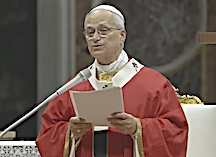
Pope Leo’s homily for the inauguration of the academic year of the pontifical universities
St. Peter’s Basilica – Thursday, 8 October 2026
First Reading: Galatians 3:1-5
1 O foolish Galatians! Who has bewitched you, before whose eyes Jesus Christ was publicly portrayed as crucified? 2 Let me ask you only this: Did you receive the Spirit by works of the law, or by hearing with faith? 3 Are you so foolish? Having begun with the Spirit, are you now ending with the flesh? 4 Did you experience so many things in vain? — if it really is in vain. 5 Does he who supplies the Spirit to you and works miracles among you do so by works of the law, or by hearing with faith?
Gospel. Luke: 11:5-13
5 And he said to them, “Which of you who has a friend will go to him at midnight and say to him, ‘Friend, lend me three loaves; 6 for a friend of mine has arrived on a journey, and I have nothing to set before him’; 7 and he will answer from within, ‘Do not bother me; the door is now shut, and my children are with me in bed; I cannot get up and give you anything’? 8 I tell you, though he will not get up and give him anything because he is his friend, yet because of his importunity he will rise and give him whatever he needs. 9 And I tell you, Ask, and it will be given you; seek, and you will find; knock, and it will be opened to you. 10 For everyone who asks receives, and he who seeks finds, and to him who knocks it will be opened. 11 What father among you, if his son asks for a fish, will instead of a fish give him a serpent; 12 or if he asks for an egg, will give him a scorpion? 13 If you then, who are evil, know how to give good gifts to your children, how much more will the heavenly Father give the Holy Spirit to those who ask him!”
Pope Leo’s Homily,
Dear brothers and sisters,
Today, we celebrate the Eucharist, invoking the gift of the Holy Spirit, so that the start of the new academic year for the Pontifical Universities will be more than just a resumption of studies and academic research.
We want to open our minds and our educational relationships to the creative breath of the risen Christ, who gives us peace and unity.
In this way, each of us can fulfill our mission and respond to God’s call and the needs of humanity.
Therefore, let this new beginning be a truly ecclesial moment, in which gathering around the Lord’s table nourishes our shared mission.
In this way, no one will teach, study, or conduct research solely for themselves, but rather, together with and for others, and above all, with and for the Lord.
As we have heard in the Letter to the Galatians, the mind is fundamental to both faith and mission.
Concerned by news from the Galatian communities, the Apostle Paul wrote a letter inviting them to reflect.
Though it may seem like a rebuke, it is actually an appeal to reason, memory, and critical thinking.
Throughout history, there have always been false teachers who exploit the religious sentiments of believers for their own benefit, often pushing them to take certain aspects of their teachings too far at the expense of the whole — the whole being Christ and his gospel.
Dear friends,
Consider studying as a service to faith and truth: for your own good and for the good of the many brothers and sisters for whom the Lord gave his life.
While encountering him indeed brings joy and enthusiasm, it is never a matter of being “bewitched” or “enchanted” (Galatians 3:1).
Posing questions in light of God’s Word and the Church’s tradition is an essential part of the journey of faith in following Jesus Christ.
For this reason, the Church desires and is responsible for safeguarding the integrity of the treasure of Revelation, developing a prayerful understanding of it within diverse contexts, and promoting scholarly reflection, cultural mediation, and practical application.
These are all expressions of a single love that calls you today, sustains you, and sets you on this shared quest.
It is a mission.
Our vocations may differ, but the mission is one
We are given a further piece of advice from the words of Saint Paul, who urges the Galatians to remember where they began.
He wrote: “Are you so foolish? Having started with the Spirit, are you now ending with the flesh? Did you experience so much for nothing?” (Galatians 3:3-4).
Therefore, intelligence must draw on memory
The mind should do more than compile data, which algorithms can do more quickly than humans.
It should also recall lived experiences, which contain depths of meaning that only the human soul can recognize.
The mind should connect more deeply with the goodness of these experiences.
Everything good begins “with the Spirit” and possesses a breath, dynamism, and sense of communion that are engraved upon the heart once experienced.
Routine, ambition, rivalry, and other negative factors can divert our attention and energy over time, leaving us exhausted, listless, quarrelsome, and sad.
Therefore, we must return to the heart.
That is where it all began—the beginning to which we can always return.
Dear friends, Guard your hearts.
Whether you are students, researchers or teachers, protect your hearts, so that you may live every stage of life and every responsibility “with the Spirit.”
Dear friends,
During your time at university, nurture your friendships, which are a precious gift, especially when they are lived out in a shared search for truth in Christ.
Stay connected to the People of God, appreciate its sensus fidei, and be open to its questions.
Do not forget the poor, who are like a persistent friend who knocks during the night (Luke 11:5–13).
Integrate your studies into your life and your life into your studies, following the logic of the Incarnation.
Apart from this, Revelation falls silent.
The further we stray from the reality that the Son of God embraced with infinite love, the fewer opportunities we will have to understand and the less we will have to say.
Sisters and brothers, let us listen to God’s longing, which comes knocking once more today, and bring it into scientific research.
Let us share what nourishes us.
Many do not have the same educational opportunities that we have.
Let us open the door and not shut ourselves off.
As I mentioned in my first encyclical, today, we are called to emulate the people of Nehemiah’s time.
Together, we must build a city where God can dwell with all of humanity in peace.
Everyone has a role to play in this undertaking, and collaboration is essential.
For instance, those grappling with the fragmentation of knowledge and the impact of new technologies on the human mind recognize the need for a healthy attitude that incorporates silence, in-depth study, reading, and judicious analysis.
Without these elements, inner freedom may be compromised.
The study of theology is no stranger to these challenges.
In the construction of the “City of God,” theological research illuminates the work of everyone involved and serves as a meeting point for diverse fields of knowledge.
The ecclesial community in Rome, in particular serves as a meeting place and a forum for dialogue and mutual enrichment among diverse sensibilities, cultures, and traditions.
Within this community, the Gospel reveals its inexhaustible treasures.
Dear brothers and sisters,
May you make the most of your years in Rome.
Don’t let them pass in vain.
Peter confessed his faith here, even unto martyrdom.
Paul, the great universal translator of the Christian experience for so many peoples, languages, and cultures, finished his race here, having kept the faith (2 Timothy 4:7).
Look around you at the university—the world is in your classrooms.
You are studying alongside people from Africa, Asia, the Americas, Europe, and Oceania. Don’t just sit next to each other; get to know each other.
Talk to each other. Listen to each other.
Share your experiences of the Church. Pray together. Share moments of leisure.
Forge friendships that will last a lifetime.
The Lord tells us: “Ask, and it will be given you; seek, and you will find; knock, and the door will be opened for you. For everyone who asks receives, and everyone who seeks finds, and for everyone who knocks, the door will be opened” (Luke 11:9–10).
Encouraged by this promise, let us persevere together in prayer.
Let us entrust the new academic year to the maternal intercession of Our Lady, Seat of Wisdom, and welcome the Holy Spirit, whom our heavenly Father never fails to grant to those who ask with filial trust.