Pope Leo’s address to a meeting with the Argentina Authorities,
Civil Society and The Diplomatic Corps
“Palacio Libertad, Centro Cultural Domingo Faustino Sarmiento” (Buenos Aires)
Sunday, 8 November 2026
___________________________________
Mr President of the Republic, distinguished Authorities and Members of the Diplomatic Corps, Ladies and Gentlemen, I am very pleased to be here today in the beloved land of Argentina.
Mr. President, thank you for your kind words and for extending the welcome of your fellow citizens to me.
I also greet the members of the diplomatic corps and the other authorities present.
I extend my affectionate greetings to all the Argentinian people.
I have come as the Successor of the Apostle Peter and, therefore, as a pastor.
I wish to meet with the pilgrim Church in this land and address the entire nation, including those who serve it. The Church accompanies the lives of all people through its mission.
Consequently, it offers those in public office a Gospel-inspired message aimed at safeguarding the dignity of every person, civic concord, and the common good.
My arrival in this land holds personal significance.
For years, the universal Church listened to the voice of an Argentinian pope who cherished the places, people, and faith he experienced here, carrying them with him in his memories and in his heart.
Today, as his successor in the Petrine ministry, I am retracing his steps in a country whose history would later become intertwined with that of Pope Francis.
Coming to the land where he was raised brings me closer to the greater history of generations of men and women who have inherited this homeland before and after him and left part of themselves here.
Some were born here; some came from afar and found a home here; and some belong to indigenous peoples whose presence predates the birth of the nation.
From this meeting of diverse backgrounds and experiences, a people have gradually emerged—a people who have learned to open their doors, make room for the newly arrived, and preserve a remarkable ability to rebound and move forward, even amid times of difficulty.
They have all contributed to the Argentina that I now have the joy of visiting.
No generation builds its homeland from scratch. They inherit it.
They inherit it through a language and bonds that predate them, through institutions founded by others, and through assets grown thanks to the work of many.
This history contains both reasons for gratitude and painful memories.
Each generation must decide what to preserve, confront past injustices, and contribute to the shared material and spiritual heritage.
The nation you have today will be inherited by others tomorrow.
Argentina’s culture offers some of the most distinctive expressions of its heritage.
From José Hernández’s Martín Fierro to the pages of Jorge Luis Borges and the other writers who have enriched the Spanish language with Rioplatense accents.
Your country has made itself heard with a recognizable voice far beyond its borders.
This voice is also heard in the tango, born from the fusion of diverse neighborhoods, ports, and backgrounds.
Argentina’s culture is evident in its music, traditions, theater, and everyday gestures. Sharing a mate, for example, transforms a moment of relaxation into an opportunity for conversation and connection.
These are various expressions of a collective memory that has been passed down from previous generations and entrusted to future ones.
The Christian faith is deeply rooted in this heritage.
It has left its mark on the nation’s memory and lives on in the countless Argentinians who have found meaning, hope, and fellowship in the Gospel.
Sharing a common heritage means learning to live together, even amid differences of opinion.
History teaches us how much a people can grow when they transform their disagreements into opportunities for dialogue and connection.
Democracy is part of Argentina’s heritage that must be safeguarded.
Values such as the freedom to elect one’s leaders, participate in public life, express one’s convictions freely, have confidence in the law, and view institutions as serving all interests have been consolidated over time.
Each generation must care for and strengthen these values.
Democracy is strengthened by the daily conduct of public life: being willing to listen, using words carefully, patiently searching for agreement, and viewing those with different views as fellow citizens with whom we share a common future.
This fosters a sense of trust, allowing a society to confront its differences while preserving its unity.
Those entrusted with public office have a particularly demanding task.
Authority is most authentic when it is exercised as service, looking beyond the immediate and using power to promote the welfare of all.
Those who exercise authority must act prudently, acknowledge the limits of their power, and make decisions that benefit the entire community.
The common good that authority serves must be discerned in the circumstances of everyday life.
The family is the basic unit of society and plays an essential role.
Within the family, each individual learns that his or her life is connected to others and that he or she is responsible for them.
At home, we learn to care for the vulnerable, forgive, share, and support those in need. Many men and women also receive their first introduction to faith within the family.
The ability to earn a living through one’s own work is a fundamental element of the common good.
This land recognizes and appreciates the efforts of all who work for a living, whether in the countryside, cities, shops, factories, schools, or hospitals.
It also recognizes and appreciates entrepreneurs and those who work tirelessly to support their families.
Work enables men and women to provide for their loved ones, develop their abilities, and feel that they are contributing to their homeland’s development.
For this reason, efforts should be made to promote opportunities, stimulate private initiative, and ensure that economic growth benefits the disadvantaged.
I think of families facing an uncertain future, the unemployed, and the elderly who have contributed to society for years.
I also think of those who struggle to meet their household’s needs despite hard work.
Argentina has an abundance of human resources.
To ensure this wealth benefits everyone, we must pay particular attention to the young.
The opportunities they encounter today will largely determine whether they can achieve their life goals here.
A nation must ask itself what it has failed to do when its young people must leave their homeland to make their dreams come true.
Specifically, creating conditions that allow young people to freely plan their future in Argentina means strengthening education, vocational training, universities, and research.
Throughout its history, Argentina has sought to extend education to broader sectors of society.
Thanks to these efforts, generations of Argentinians have developed their skills and contributed to the country’s development through various trades and professions.
To preserve and strengthen our commitment to education, we must provide young people with an education that allows them to discover and develop their talents for the benefit of others.
This commitment also involves trusting them, recognizing their capacity for initiative, and giving them the opportunity to contribute their ideas and take on responsibilities.
Starting now, the nation needs to rely on the intelligence, creativity, and participation of its people. With this in mind, another question arises:
What role should unborn children play in our decision-making process?
Before asking what kind of world we will leave our children, we must recognize their dignity.
Our responsibility toward future generations begins with welcoming life from its earliest moments and safeguarding it until its natural end (see 1st Epistle of John 1:1).
This dignity also requires us to show particular concern for those affected by illness, dependency, and disability.
We have a duty to care for others here, too: to alleviate suffering, to accompany them, and to ensure that every person feels that his or her life retains a value that no circumstance can diminish.
We are responsible for caring for both the earth and our fellow humans.
God has blessed Argentina with extraordinary natural resources.
The country’s fertile fields, abundant water reserves, plentiful energy sources, rich minerals, and diverse ecosystems offer vast development possibilities.
A truly human ecology combines care for creation with care for people.
This approach ensures that the use of these resources contributes to the well-being of communities and preserves the conditions that enable life and work in these areas.
Rapid technological advances are opening possibilities that were barely imaginable just a few years ago.
However, they are also raising far-reaching questions, especially regarding artificial intelligence.
Medicine, education, production, and research now have tools that can profoundly transform human life.
The consequences of using these tools and the responsibilities of those who decide how to use them require careful consideration.
Technological development requires an ethical consciousness equal to its challenges.
Many of these responsibilities extend beyond the boundaries of any single state.
Great rivers unite territories, and ecosystems stretch from one country to another. Energy, food, knowledge, and human mobility also create bonds that transcend borders.
When considering Argentina’s future, it is important to take account of the other countries on this continent with which it shares a border.
South America has abundant human and natural resources, and its peoples have historical ties and cultural traditions that provide ample opportunity for cooperation.
Argentina can contribute to this cooperation by sharing its experience and capabilities.
Increasing opportunities for encounters and collaborations is one way to jointly take on responsibilities that no single country can face alone.
This sort of cooperation is also necessary in the face of serious threats.
Organized crime, human trafficking, arms trafficking, drug trafficking, and corruption undermine social cohesion, fuel violence, and divert resources necessary for the common good.
In the face of these realities, coordinated action among states and strengthened institutions are indispensable.
The latter depends on the personal integrity of those entrusted with governance as corruption erodes citizens’ confidence in their institutions.
One of the highest expressions of this common cause is the pursuit of peace.
Each nation’s legitimate interests should be defended through dialogue, respect for the law, and constant efforts to reach agreements.
Throughout history, South America has used negotiation and understanding to overcome grave tensions.
Argentina must be prepared to engage in dialogue and ensure that it continues to bear fruit.
For its part, the Church wishes to contribute to this shared spirit of responsibility.
The Church has a long history in Argentina and across the American continent.
For centuries, it has walked alongside the peoples of the Americas, proclaiming the Gospel, celebrating faith, educating, caring for the sick, supporting the poor, and promoting peace and reconciliation.
This mission is rooted in Christ’s love, which he demonstrated by shedding his blood for all.
Today, this mission continues in parishes and communities that keep their doors open so that everyone may find a warm welcome and a sense of belonging.
“Welcome everyone” (Matthew 22:9-10) succinctly captures Gospel’s universal invitation, which extends to everyone and calls them to encounter Christ and experience conversion.
This welcome also gives rise to the Church’s mission:
“Go into all the world and proclaim the good news” (Mark 16:15).
Obedience to this command continues to bear fruit in schools, universities, social initiatives, and the daily lives of men and women who dedicate themselves to serving others in faith.
There are goods that a society requires that no public policy can produce alone.Trust, forgiveness, readiness to serve, and the recognition that one’s life has meaning beyond success or utility are cultivated in individuals’ consciences, as well as in the lives of families and communities.
Faith nourishes and sustains these values.
For this reason, the Church wishes to remain close to Argentina, share in its burdens and joys, and offer the hope that comes from the Gospel.
Looking back on the path this nation has traveled, one image comes to mind: each generation inherits a homeland from the previous one.
For a time, that generation is called to live on the land, protect it, preserve it, and help it flourish.
Then, they must pass it on to the next generation.
As Gardel sang, “Life is but a breath,” yet the good that each generation preserves and passes on endures.
Faith invites us to look even higher toward the eternal happiness that God offers us.
Dear Argentinian friends,
Much of that responsibility rests in your hands today.
Your extraordinary heritage allows you to look to the future with confidence.
It is now up to you to fulfill all that you have inherited and your Constitution’s preamble, which states, “to establish national unity.”
May those who come after you inherit a united homeland worthy of its history and potential.
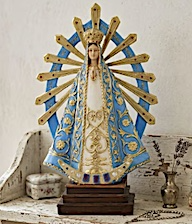
Finally, my thoughts turn to Our Lady of Luján, the silent guardian of your history.
For generations, people from every corner of the country—mothers, fathers, workers, young people, and the elderly—have come before her image, bearing the concerns and hopes of their time.
To those prayers, I now wish to add my own.
I would like to do so with the words of Pope Francis in mind, as he spoke to you, the Argentinian people, in a video message on September 30, 2016:
“May the Lord help you grow as a people.”
Through the intercession of Our Lady of Luján, I offer this heartfelt prayer to the Lord.
May she continue to watch over this land and care for each of its children, keeping them close to Jesus always. May God bless Argentina and all its people. Thank you very much.