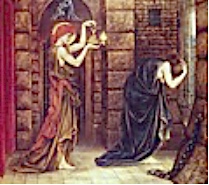
Illustration: Hope in a prison of despair 1887 by Evelyn De Morgan
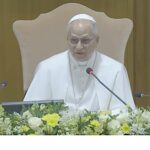
Pope Leo’s address to the international conference on
“Maps of Hope for a Regional Educational Agenda:
Mental health, Digital technologies and Education”
Consistory Hall – Saturday, 30 May 2026
“Technology connects us, but education shapes us”.
Pope Leo’s address
In the name of the Father, and of the Son, and of the Holy Spirit. Amen.
Peace be with you.
I am pleased to join you for this dialogue, which addresses one of the most urgent and crucial challenges of our time—the relationship between education, mental health, and digital technologies.
I would like to thank the Organization of Ibero-American States, the Pontifical Commission for Latin America, and the Dicastery for Culture and Education for making this initiative possible.
It was born from our shared desire to create authentic “maps of hope” together”.
This meeting focuses on the Ibero-American region, a place close to my heart. It is a land of extraordinary spiritual and human resources.
An eloquent example of this wisdom can be found in handcrafted textiles.
With their many threads and vivid colors, they teach us that no single thread is sufficient on its own to create the design. Only through patient weaving do beauty and strength emerge.
Each thread retains its own color yet takes on new meaning within the broader fabric.
In the same way, education is called to rediscover itself today.
It should not be seen as the construction of isolated individualisms or the mere transmission of skills. Rather, it should be seen as the art of weaving communion.
Ancient peoples looked to the sky to read the constellations.
They sought guidance from them and learned to recognize the rhythm of the seasons, when to sow and when to harvest.
They observed the stars not only out of abstract curiosity, but also because the stars helped them understand the right moment to act, thereby preserving harmony between humans, nature, and time.
Today we need to lift our eyes once again
(John 4:35 – Do you not say, ‘There are yet four months, then comes the harvest’?
I tell you, lift up your eyes, and see how the fields are already white for harvest).
In the Apostolic Letter Drawing New Maps of Hope, I called for the creation of a global educational constellation, in which every institution, every culture and every people can contribute to illuminating humanity’s path.
Every culture finds meaning in observing the constellations.
All cultures are called to collaborate in charting a common course and deepening our awareness of our shared humanity.
Recognizing this significant cultural heritage can help us address one of the most pressing issues of our time: the loss of inner purpose.
Many young people have sophisticated technology, yet struggle to find meaning in life, hope, love, and even suffering.
Loneliness and psychological fragility often stem from a silent question: “Does my life have any meaning? Is there reliable hope for the future?”
In the aforementioned Apostolic Letter, I wrote that we are a desire, not an algorithm (Drawing New Maps of Hope, 4.1).
When human beings are reduced to performance, consumption or a statistical value, profound inner suffering inevitably arises.
Many young people today live under the weight of expectations and the pressure to perform, immersed in a frenzied competitiveness that generates anxiety, the fear of not being good enough, and disorientation.
For this reason, we must not approach the issue of mental health as only a clinical or technical matter. The contributions of science, psychology, medicine, and neuroscience are undoubtedly indispensable.
However, we also believe that human beings can live authentically and overcome their inner frailties within a horizon of meaning.
When this horizon darkens, however, inner emptiness, isolation, and despair increase.
Conversely, when a person discovers that their life has value and that they are loved, awaited, and called to a purpose in the world, hope is born.
Hope is not a naive illusion; it is a spiritual force that sustains life, even in the most difficult moments.
That is why I wanted to include the goal of cultivating inner life among the objectives of the Global Education Compact.
It is not enough to connect young people to digital networks if they remain disconnected from themselves, others, and their inner selves.
Cultivating inner life means helping younger generations rediscover silence and reflection; the ability to ask questions; the depth of relationships; and openness to the transcendent.
In order to listen to the soul, one must sharpen one’s hearing because its voice is a whisper, not a shout (cf. 1 Kings 19:9–16 — Elijah Meets God at Horeb).
And there Elijah came to a cave, and lodged there; and behold, the word of the Lord came to him, and he said to him, “What are you doing here, Elijah?” 10 He said, “I have been very jealous for the Lord, the God of hosts; for the people of Israel have forsaken thy covenant, thrown down thy altars, and slain thy prophets with the sword; and I, even I only, am left; and they seek my life, to take it away.” 11 And he said, “Go forth, and stand upon the mount before the Lord.” And behold, the Lord passed by, and a great and strong wind rent the mountains, and broke in pieces the rocks before the Lord, but the Lord was not in the wind; and after the wind an earthquake, but the Lord was not in the earthquake; 12 and after the earthquake a fire, but the Lord was not in the fire; and after the fire a still small voice. 13 And when Elijah heard it, he wrapped his face in his mantle and went out and stood at the entrance of the cave. And behold, there came a voice to him, and said, “What are you doing here, Elijah?” 14 He said, “I have been very jealous for the Lord, the God of hosts; for the people of Israel have forsaken thy covenant, thrown down thy altars, and slain thy prophets with the sword; and I, even I only, am left; and they seek my life, to take it away.” 15 And the Lord said to him, “Go, return on your way to the wilderness of Damascus; and when you arrive, you shall anoint Hazael to be king over Syria; 16 and Jehu the son of Nimshi you shall anoint to be king over Israel; and Elisha the son of Shaphat of Abel-meholah you shall anoint to be prophet in your place.).
Technology connects us, but education shapes us.
To educate means accompanying young people in discovering not only how to live, but also why to live. In this educational mission, public institutions, schools, universities, families, religious communities, the world of culture and the world of communication are called to work together.
No one can face such profound and complex challenges alone.
Therefore, I encourage you to strengthen the network of cooperation you are building with each other and the Holy See.
In this era of digital transition, we are called to be a guiding light for many people, especially young people, who are seeking reliable points of reference to guide them through life.
We need visionaries who can create new cultural syntheses.
They must have the courage to unite thought and life, contemplation and action, and care for the poor and the search for meaning.
At the same time, they must safeguard the profoundly human heritage of education.
May the Virgin Mary, the ideal educator, inspire us on this journey. May she guide our efforts to instill confidence in the younger generations so they can dedicate themselves to building a more just and fraternal world.