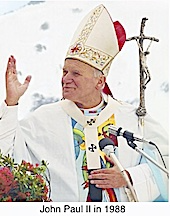
Pope John Paul II’s Homily at world retreat for 5000 priests
Tuesday, 18 September 1990
Due to shortage of content, due to holiday period, we researched back to our first publication of
“ThePopeSpeaks” in 1990 when Pope John Paul II explained to 5,000 priests that evangelization is not possible without input by the Holy Spirit
“Evangelization, will never be possible without the action of the Holy Spirit.”
“The eyes of all in the synagogue were fixed on him” (Luke 4:20).
1. Dear brothers in the priesthood, our inner eyes are now fixed on Jesus of Nazareth.
Filled with the Holy Spirit, he is “the first and greatest evangelizer.”
He is the supreme model and the inexhaustible source from which the evangelizing mission of the Church and all her members derive day after day.
Jesus presents himself and his mission, beginning with the Spirit:
“The Spirit of the Lord is upon me.”
These are the prophetic words of Isaiah that he says are fulfilled in him: “Then he began to say, ‘Today this scripture has been fulfilled in your hearing'” (Luke 4:18, 21).
The Holy Spirit is the inner principle, strength, and permanent dynamism of the Lord Jesus’s evangelizing mission.
The same Spirit is at the root of all evangelization throughout history.
As Paul VI wrote in the apostolic exhortation Evangelii Nuntiandi (n. 75), “Evangelization will never be possible without the action of the Holy Spirit.”
“Evangelization, will never be possible without the action of the Holy Spirit.”
2. “The Spirit of the Lord . . . he has sent me to preach good news to the poor” (Luke 4:18).
Isaiah’s prophecy illustrates the message.
It proclaims liberation from the many forms of slavery that oppress individuals and entire peoples.
This includes slavery linked to economic and social situations, as well as to cultures and ideologies that do not respect human dignity.
The Messiah came “to proclaim liberty to the captives and sight to the blind; to set the oppressed free.”
However, the liberation that the Messiah came to proclaim concerns the most radical aspect of God’s favor. (Luke 4:19).
Dear Brothers,
Contemporary man lives in a situation characterized by vast and complex moral slavery.
Today, sin has far more powerful and insidious means of enslaving consciences than in the past.
The contagious nature of bad proposals and examples can exploit the persuasive channels offered by the multifaceted range of mass media.
Thus, aberrant models of behavior are progressively imposed on public opinion as not only legitimate but also indicative of an open and mature conscience.
This establishes a subtle network of psychological conditioning that inhibits true freedom of choice.
Even in the face of modern chains that hinder man’s innate freedom, the Church must proclaim the Gospel of Christ as a source of liberation and salvation.
By doing so, the Church merely prolongs the evangelizing mission of Christ, her Lord, participating in it as a bride united with the bridegroom.
The Church can also repeat: “The Spirit of the Lord is upon me . . . he sent me to preach good news to the poor.”
3. In his evangelization, Jesus did more than just “proclaim” liberation; he set the oppressed free.
He was able to do this because he is the freedom he proclaimed and gave to the world.
This is “radical” freedom because he is salvation in person; he is the grace that saves and renews the heart.
It is the foundation and compendium of all “derived” freedoms that express and attest to the personal dignity of every person.
This dignity is realized through the gift of the “freedom of the children of God.”
Jesus brings about this freedom through the gift of the Holy Spirit, who is the source of God’s children’s salvation and freedom. Jesus says he is filled with this same Spirit.
“The Spirit of the Lord is upon me.” Thus, the Spirit not only constitutes the principle of Christ’s evangelizing work, but also its original content and fruit.
4. Christ’s mission derives from the Spirit.
“It springs from the interior consecration that the Spirit has wrought in the Lord Jesus: “The Spirit of the Lord is upon me, for he has anointed me and sent me…”
First the consecration, then the mission.
Consecration for the mission.
Jesus is chosen by the Father; he is the chosen one par excellence.
The Spirit “anoints” him in the womb of the Virgin Mother, filling him with holiness and making him God’s “sacred property.”
He belongs to God and his plans of salvation.
In Jesus, the “great prophet,” the Lord’s words to Jeremiah are fully and definitively fulfilled:
“Before I formed you in the womb, I knew you.
Before you were born, I consecrated you.
I have made you a prophet to the nations” (Jeremiah 1:5).
The same is true of the apostles and the Church.
They receive the gift of the Spirit as a source of sanctification and impetus for mission.
Paul VI wrote in the Exhortation Evangelii Nuntiandi (n. 75):
In fact, it was only after the descent of the Holy Spirit on the Day of Pentecost that the apostles set out in all directions to begin the great work of evangelizing the Church.
Peter explained this event as the fulfillment of Joel’s prophecy, “I will pour out my Spirit.”
Peter was filled with the Holy Spirit so that he could speak to the people about Jesus, the Son of God. Similarly, Paul is filled with the Holy Spirit before dedicating himself to his apostolic ministry, as is Stephen when he is chosen for the diaconate and later for martyrdom.
The same Spirit that inspired Peter, Paul, and the twelve apostles also descends upon those who hear the word of God.”
5. A consecration for the mission.
As priests, we are called to return to the sacramental roots of our priesthood.
The sacrament of Holy Orders has anointed us with the sacramental character and sanctified us with the gift of the Spirit.
We have been given a share in the anointing and sanctification of Jesus himself.
This gift of “holiness” enables and requires continuous “sanctification.”
The commitment to moral holiness flows from the ontological holiness conferred in the sacrament of Holy Orders.
This holiness-sanctification must be the basis of our evangelizing mission.
Thus, we are invited to grasp the many profound links between our daily commitment to priestly sanctification and our evangelizing work.
6. The first link can be formulated as follows: Sanctification is a condition that God has set for greater evangelization effectiveness.
The Gospel of God certainly has its own objective efficacy, which derives from its status as the word of God, not a human word.
However, by hiring free and responsible men to collaborate in the work of salvation, God wished to make the efficacy of this work depend on them as well.
A second link is connected to the first: the supernatural power of the work of evangelization lies in the gift of the Spirit, and holiness-sanctification.
How often do we feel our own inadequacy and powerlessness when faced with the extraordinary mission entrusted to us by the Lord?
The experience of the young Jeremiah becomes our own:
“I answered, ‘Alas, Lord God, behold, I do not know how to speak, for I am young'” (Jeremiah 1:6).
However, the gift of the sanctifying Spirit also enables us to hear the Lord’s comforting words addressed to his prophet.
“But the Lord said to me, ‘Do not say, ‘I am young,’ but go to those to whom I am sending you and tell what I command you. Do not fear them, for I am with you to protect you” (Jer 1:7-8).
Our confidence and optimism are founded here.
Nothing can break it because nothing is stronger than God.
If we cling to him in faith, he will also make our hearts hear what he said to the apostle Paul: “My grace is sufficient for you; for my power is fully manifested in weakness” (2 Cor 12:9).
A third link emerges at this point, and it is the most profound one:
this same sanctification becomes evangelization.
Holiness – sanctification itself – becomes the proclamation of Christ, indeed a gift from Christ.
Yes, because the Gospel is not just the series of “truths” that Jesus proclaimed,
but he himself is the way, the truth and the life.
Only those who possess Christ, because they desire him and love him, are in intimate, permanent and progressive communion of life with him.
They become credible witnesses and evangelizers.
7. “The Spirit of the Lord is upon me; for this reason he has anointed me; and sent me for . . . to proclaim a year of the Lord’s favor” (Is 61:1-2; Lk 4:18-19.).
The “Year of the Lord’s Favor” must resonate within the hearts of us all.
Only then will it be able to resonate throughout the history of humanity at the beginning of the third millennium of the Christian era.