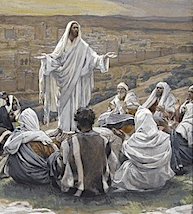
Illustration: The Lord’s Prayer (Le Pater Noster), by James Tissot
The following homily came from Pope Francis’ morning Mass
at Santa Marta (his Vatican home) on Monday, 18 March 2019,
On Monday, March 18, 2019, the day’s Gospel identified three steps to help us understand how to be merciful:
(Luke 6:36-38) “Judge not, and you will not be judged; condemn not, and you will not be condemned; forgive, and you will be forgiven; give, and it will be given to you. A good measure, pressed down, shaken together and running over, will be poured into your lap. For the measure you give will be the measure you get back.”)
Pope Francis focused his homily on passing judgment on others and neglecting to forgive. Lent offers us the opportunity to be more merciful and generous with others.
Pope Francis’ homily March 18, 2019
In response to Abraham’s advice on how to avoid making mistakes, the Lord answers: “Walk before me and be blameless” (Genesis 17:1).
This advice to imitate God is valuable to us as well.
In today’s Gospel reading from Luke, Jesus offers advice that is difficult to follow: “Be merciful, even as your Father is merciful” (Luke 6:35).
“God’s mercy is a very great thing.
Let us not forget this.”
Many people believe that they have committed too many sins to be saved,
but they should know that God’s mercy is available until the very end.
First, “Judge not, that ye be not judged” (v. 37).
This does not seem so bad, but it is a bad habit that meddles in our lives without our noticing.”
I invited everyone to consider how many times they judge others in a day.
“If I want to be merciful like the Father, as Jesus tells me, I must ask myself, ‘How many times a day do I judge?'”
This suggested Lenten exercise begins with realizing that we are judgmental.
The second word of advice in Luke’s Gospel is to “condemn not, and you will not be condemned” (v. 37).
We condemn too much. With this habit of condemnation, we show the Lord how he should behave toward us..
Luke’s third word of advice is to “forgive and you will be forgiven” (v. 37).
Forgiveness is difficult, but it is also a commandment that stops us before the altar and before communion.”.
Jesus tells us that we should forgive our brother before approaching the altar if we have something unresolved with him.
In the “Our Father,” Jesus also taught us that receiving God’s forgiveness requires us to forgive others: ‘Forgive us our trespasses as we forgive those who trespass against us”.
By doing so, we show God how he should treat us.
Do not judge; do not condemn, forgive and in this way you will be merciful like the Father”, However, he acknowledged that this is not easy, as “we constantly judge others in our daily conversations and find it difficult to forgive.”
The day’s Gospel offers a solution for avoiding the judgment and condemnation of others while fostering forgiveness: “Give, and it will be given to you” (v. 38).
This emphasizes the importance of almsgiving and why we should be generous.
This includes not only material alms, but spiritual alms as well.
We can do this by spending time with someone in need, visiting someone who is sick, and offering a smile.