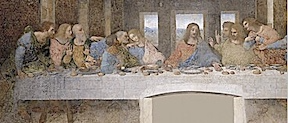
Illustration: Leonardo da Vinci’s – The Last Supper
The following text is intended to provide straightforward, written information about the Eucharist.
after viewing the following youtube:
https://www.youtube.com/watch?v=Itb30Lx3fI8&t=17s
For Catholics the Eucharist is at the center of everything.
It is about what God is doing.
At Mass Catholics believe that they are truly encountering Jesus Christ himself.
They are not just remembering Jesus.
Its much more than a symbol.
Catholics believe that the Eucharist is Jesus himself—body, blood, soul, and divinity.
That is why the Church calls it the source and summit of the Christian life.
Everything flows from it.
Everything leads back to it.
God has always wanted to be close to his people.
From the beginning of the Bible, God fed, nurtured and dwelt within them.
Consider the Old Testament:
The passive lamb was slaughtered on the afternoon of the fourteenth day of the Hebrew month of Nisan and eaten that same night (Exodus 12).
Manna came down from heaven to feed them (Exodus 16:1 – 36)
Bread and wine were offered as worshipful sacrifices.
In Genesis 14:18, when Melchizedek, the king of Salem and priest of God Most High, brought out bread and wine to bless Abraham)
All of this paved the way for Jesus to become our true food.
In John’s Gospel (chapter 6) Jesus said
“I am the living bread that came down from heaven.
Whoever eats my flesh and drinks my blood has eternal life”
This shocked some people! Many people walked away.
However, it’s important to note that Jesus didn’t say, “Wait, I meant this symbolically.” Instead, he repeated it even more strongly.
He knew it was difficult to accept, but he also knew that eternal life was at stake.
It began at the Last Supper.
The night before he died, Jesus took bread and wine and said,
“This is my body… this is my blood’.
Then he said: “Do this in memory of me!”
The Mass is connected to that moment.
In the Bible, “memory” does not simply mean recollection.
It means making something present again.
At every Mass, the sacrifice of the Cross is made present—not repeated, but represented.
Jesus offers himself to the Father, and we join him in that sacrifice.
How do Catholics explain what changes?
The Church uses the term ‘transubstantiation’.
It means that ‘what the bread and wine are’ changes’ – they still look and taste like bread and wine.
They still look and taste like bread and wine – but in the deepest reality, they are now Christ.
This transformation occurs as follows:
Through the power of the Holy Spirit and the words of Jesus, spoken by the priest.
The priest isn’t acting on his own – he acts in the person of Christ.
This is why only bishops and priests can celebrate the Eucharist.
So, the Mass isn’t just Communion. The Mass has two main parts.
First is the Liturgy of the Word, in which God speaks to us through Scripture.
The second is the Liturgy of the Eucharist, during which bread and wine are offered and Christ becomes present.
At that moment, heaven and earth meet.
What happens to a person who receives Communion?
A lot happens.
The Eucharist nourishes the soul.
It deepens our union with Christ,
It strengthens our bond with the Church and forgives venial sins.
It gives us strength to resist sin.
It sends us out on a mission.
We don’t just receive Christ—we slowly become more like him!
Catholics are careful about who receives Communion because we believe that it is really Jesus. Receiving the Eucharist is a serious act. A person must be Catholic, properly initiated, and unaware of any unconfessed mortal sins to receive. It’s about honesty and reverence, not exclusion.
Those who are not ready for communion are still welcome at Mass.
They may come forward for a blessing instead.
This is a beautiful sign of respect and a desire to grow closer to Jesus Christ.
Catholics pray in front of the tabernacle because Jesus remains present in the Eucharist even after Mass ends.
This is why we have Eucharistic adoration.
Sometimes, the host is exposed in a monstrance so people can pray in his presence.
During adoration, people open their hearts to Jesus by reading scripture, saying the rosary, or simply being there.
It is not about doing something perfectly. It is about being with Jesus.
Summary: The Eucharist is neither an object nor a symbol. It’s a person.
Jesus didn’t leave us with just a book or a memory. He left himself.
As he said: “Whoever eats my flesh and drinks my blood remains in me, and I in him!”
The Eucharist is God’s greatest act of love and his way of remaining with us until the end of time.