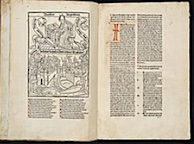
Modern Translations of St. Augustine’s City of God
Book 14, Chapters 26, 27 and 28
Chapter 26: We are to believe that in Paradise, our first parents begot offspring without shame.
In Paradise man lived as he desired so long as he desired what God had commanded.
He lived in God’s enjoyment and was good by God’s goodness.
He lived without want and had the power to live eternally.
He had food so that he would not hunger, drink so that he would not thirst, and the tree of life so that old age would not waste him.
His body was free from corruption and the seeds of corruption that could produce unpleasant sensations.
He feared neither inward disease nor outward accident.
His body was blessed with sound health, and his soul with absolute tranquility.
Just as there was no excessive heat or cold in Paradise, its inhabitants were exempt from the vicissitudes of fear and desire.
There was no sadness or foolish joy;
True gladness flowed ceaselessly from the presence of God, who was loved “out of a pure heart, and a good conscience, and faith unfeigned.”
The honest love between husband and wife created a harmonious bond.
Their body and spirit worked together harmoniously, and they kept the commandment without effort.
No languor made their leisure wearisome, and no sleepiness interrupted their desire to work.
In such ease and happiness, let us not suspect that offspring could not have been conceived without lust.
Those members would have been moved by the same will as the rest.
Without the alluring stimulus of ardor, the husband would have poured into the bosom of his wife with tranquility of mind and body and without any corruption of integrity.
Experience cannot be proven, yet it is not to be disbelieved.
When the body was not affected by turbulent heat, but rather by spontaneous power, the male seed could have been introduced into the womb of the spouse with the female genitalia’s integrity preserved.
Just as the flow of menstrual blood can now be emitted from a virgin’s womb with its integrity preserved.
Indeed, it could have been introduced in the same way that it can be expelled.
So that, in giving birth, it would be the impulse of maturity, not the groan of pain, that relaxes the female viscera. Likewise, in bearing and conceiving, it would be voluntary use, not the desire of lust, that unites both natures.
We speak of things that are now considered shameful. Although we try to conceive of them as they were before they became shameful, necessity compels us to limit our discussion to the bounds set by modesty rather than extend it as our moderate faculty of discourse might suggest.
Since our first parents did not experience what I have been speaking of — sin and its merited banishment from Paradise anticipated this passionless generation on their part — when sexual intercourse is spoken of now, it suggests to men’s thoughts not the placid obedience to the will conceivable in our first parents, the violent acting of lust they experienced.
However, Almighty God, the supremely good and supreme Creator of all natures, aids and rewards the good while abandoning and condemning the bad.
He rules over both and was not destitute of a plan by which He might populate His city with the fixed number of citizens that His wisdom had foreordained, even from the condemned human race.
He does not discriminate among them by merits since the whole mass was condemned as if from a vitiated root.
Rather, He discriminates by grace and shows not only in the case of the redeemed but also in those who were not delivered how much grace He has bestowed upon them
Everyone acknowledges that he has been rescued from evil not because he deserves it, but because of God’s gratuitous goodness.
This occurs when he is singled out from the company of those with whom he might justly have shared a common punishment and is allowed to escape unharmed.
If this is true, why should God not have created those whom He foresaw would sin?
He was able to demonstrate through them both the guilt they deserved and the grace He bestowed.
Under His creating and disposing hand, even the disorder of the wicked could not pervert the right order of things.
Chapter 27: Of the angels and men who sinned, and that their wickedness did not disturb the order of God’s providence.
The sins of men and angels do not impede the “great works of the Lord that accomplish His will.”
For He who by His providence and omnipotence distributes to everyone his own portion is able to make good use not only of the good, but also of the wicked.
Thus, God made good use of the wicked angel.
In punishment for his initial evil intention, the angel was doomed to an obstinacy that now prevents him from willing any good.
Why, then, should God not have permitted him to tempt the first man, who was created upright—that is, with a good will?
Man had been constituted in such a way that, if he looked to God for help, his goodness would defeat the angel’s wickedness.
However, if he abandoned God, his Creator and Sustainer, in favor of prideful self-indulgence, he would be conquered.
If his will remained upright, by leaning on God’s help, he should be rewarded;
if it became wicked, by forsaking God, he would be punished.
However, even this act of trusting in God’s help could not be accomplished without God’s help.
Although man had the power to relinquish the benefits of divine grace by pleasing himself,
Just as it is not in our power to live in this world without nourishing ourselves with food, yet it is in our power to refuse this nourishment and cease to live, as those who commit suicide do, so too was it not in man’s power, even in Paradise, to live as he ought without God’s help.
However, it was in his power to live wickedly, though he would thereby cut short his happiness and incur just punishment.
Since God knew man would fall, why did He not allow him to be tempted by an angel who hated and envied him?
He was not unaware that He would be conquered; rather,
He foresaw that the devil himself would be conquered by the man’s seed, aided by divine grace, to the greater glory of the saints.
Everything was brought about in such a way that no future event escaped God’s foreknowledge and His foreknowledge did not compel anyone to sin.
This demonstrates to intelligent creatures, both human and angelic, the great difference between the presumption of the creature and the protection of the Creator.
Who would dare say or believe that God was unable to prevent angels and humans from sinning?
God preferred to leave this in their power to show them what evil could be wrought by their pride and what good could be wrought by His grace.
Chapter 28: On the Nature of the Two Cities: The Earthly and the Heavenly.
Accordingly, two cities have been formed by two loves:
the earthly city, formed by the love of self even unto the contempt of God;
and the heavenly city, formed by the love of God even unto the contempt of self.
In short, the former glories in itself, while the latter glories in the Lord.
One seeks glory from men, but the other’s greatest glory is God, the witness of conscience.
One lifts up its head in its own glory, while the other says to God, “You are my glory and the lifter up of my head.”
The former is ruled by the love of ruling, while the latter is ruled by love.
The princes and nations of the former subdue one another; the princes and subjects of the latter serve one another.
The princes of the former take thought for themselves; the princes of the latter take thought for all.
One delights in its own strength, represented by its rulers.
The other says to God, “I will love you, O Lord, my strength.”
Therefore, the wise men of one city have sought profit for their bodies or souls, or both.
Those who have known God did not glorify Him as God or give thanks; but their thinking became futile and their foolish hearts were darkened.
Professing to be wise, they became fools.”
In other words, they gloried in their own wisdom and were possessed by pride.
They exchanged the glory of the incorruptible God for images of corruptible humans, birds, four-footed beasts, and creeping things.
They were either leaders or followers of the people in adoring images and “worshipped and served the creature more than the Creator, who is blessed forever.”
In the other city, however, there is no human wisdom.
There is only godliness, which offers due worship to the true God and seeks its reward in the company of saints and holy angels, so that “God may be all in all.”