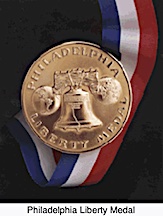
Pope Leo’s acceptance speech for the Liberty Medal of The National Constitution Center (USA)
Friday, 3 July 2026
Dear friends,
It is a great honor to accept the Liberty Medal from the National Constitution Center in a year that marks the 250th anniversary of the United States of America’s founding with the signing of the Declaration of Independence on July 4, 1776.
On the eve of this momentous occasion, I extend my warm greetings to all gathered at the National Constitution Center in Philadelphia.
As a son of this great country, founded by courageous men and women who dreamed of liberty and a better life for themselves and their children, I join you in asking for God’s blessings on America’s future. May the lofty ideals enshrined at the beginning of the Declaration of Independence continue to guide the nation’s growth in unity, justice, and peace.
From a young age, many of us have admired the eloquence of those words and their resounding appeal to the law of nature and nature’s God as the basis for their assertion that all people are created equal and endowed by their Creator with certain inalienable rights, including life, liberty, and the pursuit of happiness.
Although the claim is couched in the language of the Enlightenment, it is ultimately grounded in an understanding of the human person inspired by the biblical vision of humanity being created in God’s image.
Here, we find the basis of human dignity, which precedes the establishment of any state and constitutes its purpose.
For the past two and a half centuries, the firm resolve to achieve the nation’s founders’ noble vision has made America a byword for freedom. The country has opened its doors to successive waves of immigrants, enabling them and their children to play a role in shaping the nation’s future.
It was this same love of freedom that inspired the United States to look beyond itself and champion the cause of freedom beyond its own borders during the darkest hours of the last century, at the time of the two world wars.
As every American knows, however, building a society that embodies the ideals of liberty and justice for all has not been easy. In many respects, it is still a work in progress.
The effort to realize this vision must be taken up anew by each generation in the face of ever-new challenges.
As we look to the future today, this historic anniversary gives us the chance to once again reflect on the nation’s founding principles. We hope that America will always be true to the dream that earned it the title of the land of the free and the home of the brave.
The right to life was the first right enshrined by the nation’s founders,
No one who is deprived of life can enjoy liberty or pursue happiness.
A country’s vitality is deeply tied to the value it places on human life in all its forms and conditions. This acknowledges the dignity that is inherent in every human being simply by virtue of their existence.
The inherent worth of human life has inspired generations to praise the Creator’s marvelous works and stand in reverence before such a precious gift.
(Psalm 139:14 — “I praise you, for I am fearfully and wonderfully made.” Wonderful are your works! You know me well.)”
Indeed, it is precisely this reverence that we must continue to cultivate—one that moves individuals’ hearts and inspires laws that recognize and safeguard this gift from conception to natural death.
Reverence will also aid us in recognizing that we are guardians and stewards of those entrusted to our care.
A nation’s moral greatness is manifested, above all, in its capacity to support, protect, and cherish the lives of all, especially the most vulnerable and those whose worth is questioned.
Following the right to life, liberty has been and continues to be the most important principle for the men and women who have sought a new beginning within this nation’s borders, often equating it with previously undreamed-of hope.
Though often understood as the ability to act as one wishes authentic freedom runs much deeper.
It is based on a person’s ability to recognize truth and do what is right, even at great cost—a sacrifice familiar to many who have worked to build this country.
The desire for truth and freedom, as well as the pursuit of happiness, inspires people of all generations to ask fundamental questions about life’s meaning, our ultimate purpose, and God. It is proper for generous hearts to endeavor to answer these questions sincerely.
These answers determine the direction we give our lives. America has long championed the religious freedom necessary to responsibly follow the dictates of our conscience, free from fear and coercion, as enshrined in the First Amendment to the United States Constitution.
This freedom holds sacred the inner sphere of the person, where convictions are formed and conscience guides decisions made in the intimacy of the human heart.
This same freedom ensures the right of every person to worship according to their beliefs and the right of individuals, communities, and associations to publicly express their faith. Religious freedom has given rise to the American tradition of interfaith dialogue and interreligious cooperation to promote the public good and enrich debates on the great moral and ethical issues that have shaped the nation’s history.
I hope this tradition continues to bear fruit in a public discourse marked by moderation and respect for others’ views, as well as an ongoing effort to find common ground in promoting peace and reconciliation at home and abroad.
The forefathers and foremothers of this country, hailing from diverse backgrounds, religions, and languages, found common ground and the strength to pursue a better future.
The principles that inspired America’s founders — principles rooted in the truth of the human person — brought them together under a common cause and dream.
That dream was strengthened by unity, giving rise to the United States of America under God. E pluribus unum: out of many, one.
For a nation to flourish, it must be united by ideals that do not fade with the passing of time, not by goals bound to momentary endeavors.
May the principles we reflected on today—a shared human dignity, equality, and the rights outlined in the Declaration of Independence—ever be a source of unity and a guiding light for the present and future.
As I accept this award on the 250th anniversary of this great nation’s founding, I pray that we will renew our commitment to the ideals that have made America a country that values peace and prosperity. May we continue to be a nation characterized by generosity and nobility of heart.
I commend you all, as well as the nation’s future, to the One who is the source of true freedom and lasting peace—the One whose name is Peace.
May God bless America! Thank you!