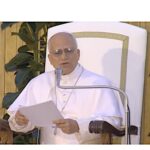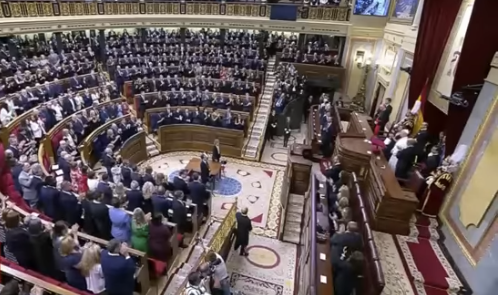
Pope Leo’s address to Members of the Spanish Parliament
Congress of Deputies (Madrid) – Monday, 8 June 2026
I thank the President for her kind words, as well as for the invitation the Apostolic See received for my visit to this country.
I am also grateful for the courtesy of welcoming me to this historic Palace of the Congress of Deputies, a prominent center of the institutional, legal and democratic life of the Kingdom of Spain.
I come before you as the Bishop of Rome and Shepherd of the Catholic Church, aware that the mission entrusted to the Successor of the Apostle Peter, as the principle and foundation of the unity of the Bishops and the faithful, places the Holy See, in a special way, in dialogue with peoples and with States.
My presence among you is intended as a gesture of closeness to Spain, within the framework of mutual co-operation, and as a message offered in the spirit of service to the human person.
The Church “walks alongside humanity,” shares its hopes and its wounds, listens to the questions of every age and allows herself to be challenged by “everything concerning the lives of contemporary men and women.
For this reason, when the Church addresses anything concerning public life, she does so while respecting the proper mission of institutions and the legitimate responsibility of those who have received the mandate to legislate.
She recognizes “the autonomy of earthly realities” and “the distinction between the ecclesial community and the political community”; and, precisely from this awareness, the Church offers a reflection born of the desire to serve the common good and to recall what makes human coexistence truly human.
In this chamber, social coexistence takes legal form.
Here, differences are heard, sorted out, and, when possible, transformed into shared decisions.
For this reason, beyond the legitimate diversity of positions, every legislative task ultimately confronts a decisive question: what conception of the human person inspires laws, and what kind of society do those laws build?
In this regard, Spain has a particularly rich heritage.
Its geographical and political identity is intertwined with a history in which faith and reason, art and law, tradition and thought have come together in a fruitful manner.
In its cathedrals and universities, its immortal literature, its legal institutions and the very spirit of its people, endures a heritage that has shaped its way of living out freedom, practicing justice and organizing communal life.
From the timeless pages of Don Quixote, where Cervantes proclaimed that “freedom… is one of the most precious gifts that heaven has bestowed upon men” (Don Quixote de la Mancha, II, 58), to the spiritual depth of St. Teresa of Ávila, and from the great Spanish legal tradition to the metaphysical restlessness of Unamuno, who recalled that man “was not resigned to die utterly” (The Tragic Sense of Life, I), Spain has known how to view the human being as more than just a cog in the social, economic or political order.
It has recognized the human being as a creature open to truth, endowed with freedom, and driven by a thirst for eternity that no temporal reality can quench — in a word, as someone whose dignity takes precedence over all utility and to whose service legislative action is subject.
For this reason, when discussing the human person today, it is only natural to think of Salamanca and the ideas that emerged there.
The symbolic presence of King Ferdinand and Queen Isabella in this hall recalls the moment when Spain found itself facing historic responsibilities of universal scope.
A few years later, the University of Salamanca would undertake the moral and legal reflection that the situation demanded.
Five hundred years ago, at that university, when new worlds and immense possibilities in relations among peoples were growing, some teachers understood that reason could not be invoked to legitimize whatever force or self-interest seemed convenient.
They introduced the question of the intrinsic value of every human being and the moral limits of power into historical discernment.
It must be acknowledged that society and the Church herself did not always live up to these insights found in their own Christian tradition.
That question broadened intellectual and moral horizons that transcended its historical moment.
The concept of the whole world, or a human community broader than any power, made it possible to acknowledge legal and moral connections between peoples.
From Spain, the School of Salamanca — particularly Fray Francisco de Vitoria and other Dominicans and Jesuits — developed a legal and moral consciousness that recognized the responsibility that accompanies authority and the rights and duties of every human being.
This aspiration continues to resonate today, as we strive for dignity, justice, and the common good in our social relations, both nationally and internationally.
This is one of Spain’s great legacies: uniting historical action with moral clarity.
Born on the banks of the Tormes that contribution transcended classrooms and libraries to become part of a broader consciousness shared by the international community.
This community continues to ask itself how to build peace based on the recognition of individuals rather than the imposition of force.
This legacy lives on in this Parliament every time lawmakers ask themselves how to ensure that what is possible is just, that what is legal is truly humane, and that the will of the majority safeguards the common good and respects that which no majority can legitimately violate.
The “Salamanca Question” continues to guide the work of those who serve in public life.
The new worlds growth before us today are not marked on maps.
They unfold in technology, the economy, biomedicine, and the digital realm.
In these areas, human power reaches into increasingly sensitive aspects of personal and social life.
Progress offers admirable possibilities.
Today, we see this in the unique development of artificial intelligence and new technologies.
As I recalled in my recent Encyclical, technology in itself is not neutral because it takes on the face of those who conceive, finance, regulate and use it.
Therefore, in the face of the transformations of our time, we must focus our discernment on the place of the human person in our decision-making processes, as well as on how the dignity of work, solidarity, social policy, and the common good are being addressed in new ways today.
This discernment begins with a fundamental affirmation:
Every just society is founded on the recognition of the inherent dignity of every human being.
This dignity is not granted by the state and cannot be subordinated to shifting social consensus or the whims of the majority.
Every human being possesses it simply by virtue of their existence, and for this reason, it must guide every positive legal system.
The Christian faith proclaims this truth based on revelation, and human reason can recognize it as a requirement inscribed in the nature of humanity.
When this conviction is upheld, the law becomes a safeguard for all, protecting against the imposition of particular interests or agendas.
Based on this, I have the responsibility today to calmly and firmly address those who bear the grave responsibility of legally ordering social coexistence.
This coexistence is threatened by throwaway culture, as Pope Francis has often warned.
If life ceases to be recognized as a fundamental value, what future can our societies have?
Can a community that casts the unborn child, the elderly, the sick, the silent sufferers, and those entirely dependent on others into the shadows be considered just?
Defending human life is not a partisan issue or a religious interest; it is a goal of civilization.
Every human life must be recognized and safeguarded from conception to natural death, regardless of the circumstances.
When this certainty is obscured, the most vulnerable become the first victims, and the law loses its deepest meaning—to serve and protect every person.
Therefore, a nation’s moral greatness is manifested primarily in its capacity to support, protect, and love the most fragile lives.
The common good is, in a certain sense, the “social expression of the dignity recognized in every person”.
It does not consist in the mere sum of particular interests, but rather in the sum of those conditions of social life which allow social groups and their individual members relatively thorough and ready access to their own fulfillment.
When the common good ceases to be a shared horizon, public action runs the risk of fragmenting into partial interests, incapable of safeguarding what belongs to all.
In this context, the family takes on particular importance. As the primary human reality and the natural foundation of the community, the family is of great significance.
Within the home, generations intertwine, and a living memory is passed on, providing society with inner continuity.
When families are supported, nations become more spiritually and socially stable.
The family is the first school of humanity, where one learns the basic grammar of living together before anywhere else: welcoming life, caring for others, forgiveness, service, and belonging.
Educational institutions also play a crucial role in this endeavor.
There, new generations can learn to seek and love the truth and reflect on the meaning of life and the dignity of every person.
Many parents who want their children to learn how to interact with others, think critically, and acquire solid values have high hopes for these institutions and see them as valuable allies in their children’s education.
This collaboration must respect the “primary and inalienable right” of parents to “choose the kind of education and formation for their children in a manner consistent with their moral, cultural, and religious convictions.”
When so many people are forced to leave everything behind in search of peace, security, and a future, the affirmation of human dignity cannot remain abstract.
The tragic reality of migration challenges the conscience of nations and the ethical foundation of today’s international order.
Many men, women, and children are forced by dramatic circumstances to abandon their communities, loved ones, histories, and ties.
This reality transcends any purely demographic or economic analysis; it is an eminently moral and legal issue.
Discrimination based on national, ethnic, religious, or linguistic origin, or economic or social status seriously violates the universal principle of the equal dignity of all human beings.
The situation of migrants and refugees requires a people-focused response that addresses the root causes forcing them to leave and goes beyond merely managing migration flows.
This gives rise to a twofold demand for social justice: offering safe and legal pathways, a respectful welcome, and real opportunities for integration, while also promoting the right to remain in one’s own land.
This means working to ensure that no one should leave their home due to a lack of peace, security, or decent living conditions—including economic inequalities and the effects of the climate crisis.
In recent years, increasingly dangerous routes have brought to light the high cost of a reality that is often hidden or ignored.
Many people fall prey to traffickers and smugglers who exploit their desperation.
Strengthening prevention, rescue, and assistance for victims, especially through regional and multilateral cooperation, is necessary.
No nation can face a challenge of this magnitude alone.
Therefore, a coordinated, supportive, and effective response is indispensable—one that can guarantee protection, welcome, and real opportunities for integration to migrants.
When institutional responses are accessible, just, and coordinated, borders can become spaces for the responsible protection of human dignity instead of places of abandonment.
Ladies and gentlemen:
The world is experiencing a profound spiritual and cultural crisis that manifests as violence, polarization, and mutual distrust.
In this context, peace emerges not only as a political aspiration, but also as a moral imperative.
Peace requires public discourse that respects differing opinions, institutions dedicated to fostering dialogue, a historical memory that seeks truth and reconciliation, and a social life that can sustain civic friendship and mutual respect amid disagreement.
At the international level, peace requires diplomatic courage, ethical responsibility, and a vision for the future based on respect for the identity of each people and the obligation of states to resolve their disputes through peaceful means offered by international law.
Ultimately, every war is a painful defeat of the capacity to negotiate and of the common human consciousness that recognizes bonds of justice among nations.
While weapons may impose a temporary silence, they can never build genuine, lasting peace.
Therefore, it is a cause for concern that rearmament is once again being presented as an almost inevitable response to the fragility of the international situation in various parts of the world — including Europe.
However, true security stems from justice, patient dialogue, respect for international law, and a policy that prioritizes the lives of people over the interests that profit from war.
The development of new military technologies and artificial intelligence also demands rigorous ethical oversight so that decisions regarding life and death are never left to automated systems or removed from the moral responsibility of humans.
The international community must rediscover the indispensable value of dialogue as a patient path toward just and lasting agreements.
These agreements must be founded on respect for treaties, transparent diplomatic action, and a sincere will to prioritize peace over the use of force.
It is from this foundation that confidence and hope spring forth.
The European Union’s motto, “In varietate concordia,” (“In diversity there is harmony,”) reminds us that true unity is not about standardization, but rather about uniting in diversity.
This allows cultures, sensibilities, and traditions to be an opportunity for mutual enrichment.
Similarly, it is urgent to build a culture of reciprocity within societies themselves.
Political pluralism should not devolve into the perpetual disparagement of one’s adversary. In a mature society, conflict can become a path to peace when differences are softened by active listening and a focus on recognizing the needs, aspirations, and capabilities of all.
However, peace is not just a political or institutional reality.
It is also the product of a conscience that overcomes resentment, indifference, and hatred with reconciliation.
For this reason, peace is established and protected through language.
Words can open or close paths; they can illuminate or distort reality to the point of making an encounter impossible.
Those who hold public office have a special obligation to be mindful of their words to disarm language.
Firmness does not require contempt, nor does disagreement entail humiliation.
Respect for others also entails safeguarding the space in which their convictions, conscience, and relationship with God develop.
Paying attention to this inner realm allows for a better understanding of a fundamental right and decisive issue for every truly democratic society: freedom of thought, conscience, and religion.
This right protects the most intimate sphere of a person.
An authentic contemporary state recognizes the religious dimension of the human person, respects it, and protects it legally. It ensures that faith is not a reason for which a person must forfeit his or her contribution to society.
Without confusing the legal and moral spheres, it is worth recalling that freedom must be understood fully.
Being free means more than being free from coercion or having many choices.
It means recognizing the good and committing to it responsibly.
For this reason, a truly free society requires limitations on public power so that the freedom of individuals, communities, and associations is not unduly restricted.
From this perspective, the legitimate autonomy of the temporal order should never view religion as its enemy.
Faith does not seek to impose itself through privileges or coercion.
Yet, it cannot be silenced as if it were irrelevant to public life.
In this context, the sacramental seal of confession is of particular importance to the Catholic Church.
It is part of the broader sphere of religious freedom, which guarantees believing communities their own space for life, organization, and internal discipline (see the Conference on Security and Cooperation in Europe’s The Helsinki Final Act of August 1, 1975, Principle VII).
Legally protecting it, as is done in some professions, preserves a sacred space of inner freedom where believers can open their souls to God without fearing external pressures, as recognized by international norms.
Ladies and Gentlemen:
Please allow me a moment to reflect on the images adorning this chamber.
Natural light streams in through the skylight that crowns the room.
This light from above reminds us that politics must also acknowledge a force that precedes and transcends it.
Similarly, the paintings on the upper part of the main wall depicting the reception of the Gospel and the Decalogue remind us of something essential.
Without confusing the political and religious orders, these symbols invite us to recognize that modern freedom has also been shaped by a long tradition of conscience education deeply rooted in the Christian tradition.
In this internal education, people learned that law must serve the greater good, that justice must restrain force, that power must be legitimate, that the poor must be fully included in the community, that foreigners must be welcomed with dignity, and that human life must never be treated as a commodity.
A law does not become great simply by being enacted.
It becomes great when it is valid in form and can stand before the dignity of the person without shame.
I invite you to look at the world around you.
Don’t turn away from reality.
Remember that every decision by public authorities affects real people, especially those who have less power to make their voices heard.
Expanding one’s vision means looking more deeply at what is at stake in every public decision.
This is why, in addition to technical solutions and legal reforms, moral renewal is also necessary.
Spain has much to offer on this journey.
It has a language that bridges continents and a cultural, legal, and spiritual tradition that has successfully fostered dialogue between faith and reason, law and conscience, and unity and plurality.
This historical experience reminds us of the value of harmony and the importance of making a concerted effort to build a peaceful and just society.
May this noble nation never lose sight of its roots or the courage to face the future. May Spain continue to be a land of encounters, culture, solidarity, and hope.
May its public life always unite firm convictions with noble dialogue and great service.
May God grant peace to all nations, harmony to families, and serenity to consciences.
May days of prosperity, justice, and lasting peace descend upon the Kingdom of Spain, which is marked by the apostolic footprint of St. James and the maternal presence of Our Lady of the Pillar.
Thank you very much.