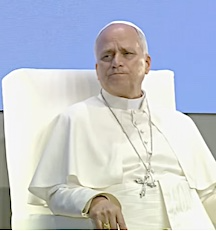
Address of Pope Leo to “Meeting the World of Work”
Buenos Aires, Pontifical Catholic University of Argentina
Monday, November 9, 2026
Scripture reading:
You did not choose me.
I chose you and appointed you so that you would go and bear fruit, fruit that will last.
Then the father will give you whatever you ask in my name. (John 15:16).
Dear friends!
Just as music elevates our spirits and transcends the ordinary,
work invites us to participate in God’s magnificent, harmonious creation.
In his Encyclical Letter to Creation, Saint John Paul II reminded us of this, writing that “man, created in the image of God, participates in the work of his Creator through his work, and in a certain way further develops and completes it to the extent of his human capacity, progressing ever forward in revealing the resources and values hidden in all creation” (25).
Work is therefore not an instrument of conflict.
Rather, it contributes to the building of social reality through the contributions of all and with respect for the order of creation.
This conviction remains valid, regardless of how much the circumstances around us change or even the structure of work change.
Today, work is confronted not only with economic conditions but also with the challenges of the ecological crisis and the irresponsible use of our planet’s resources, when considered within an anthropological foundations and global context.
When the law of the stronger prevails, work becomes an instrument of exploitation for everyone in the workforce.
Workers are evaluated solely on their performance.
In light of Pope Francis’s concept of integral ecology, this problem takes on unprecedented importance.
According to this concept, work contributes to the responsible management of creation. Technological development must be in harmony with the natural rhythms of nature and the limits of various ecosystems.
(See footnote 1 below – Encyclical Letter Laudato Si’, 11).
This concept is particularly relevant in the current era of profound changes in the structure of work, when the interests of a few seem to prevail at the expense of the well-being of the many.
As the encyclical letter to the People states, “it is not true progress that which increases the well-being of some at the expense of the degradation of ecosystems, shifting the costs to the most vulnerable communities, or worsening the living conditions of future generations”
(Magnifica Humanitas, 84).
All work and components of the world of work must be characterized by one fundamental principle: work is carried out by humankind, who commits their full potential to it, and its purpose is to fully develop the person performing it.
This is the first and most fundamental principle of the Church’s social doctrine: the dignity of the human person.
Human beings are the creators, centers, and goals of all social and economic life.
For this reason, the economy must serve people, not the other way around.
While this statement may seem purely theoretical, it is actually one of the central points of the Church’s social teaching, beginning with my predecessor, Pope Leo XIII.
In his desire to promote harmony between parties and overcome conflicts in the world of work (cf. Encyclical Letter Rerum Novarum, 16-17), Pope Leo XIII emphasized the need to strike a balance between economic principles, the perspectives of entrepreneurs and the needs of workers and their families.
Unemployment is therefore a real tragedy for those who experience it.
Losing a job means more than just losing a source of income.
It also means missing out on the chance to contribute to society, which can result in social isolation and hinder efforts to promote social cohesion and community action aimed at the common good.
As Pope Francis reminded us: “In a truly developed society, work is an indispensable part of social life, because it is not only a means of earning a living, but also a means of …
– of personal development,
– of creating healthy relationships,
– of expressing oneself,
– of sharing one’s gifts,
– of building a sense of shared responsibility for the development of the world and, ultimately,
– of living as a people” (Encyclical Letter to the People). Fratelli tutti, 162).
Here, we see the direct link between dignity and the common good.
The common good is defined as the totality of social conditions that enable communities and their members to reach their full potential.
To achieve the common good, we must overcome sterile individualism and corporate utilitarianism and promote a culture of encounter where economic growth translates into real, integral human development.
Moreover, from a Christian perspective, we view work as a form of sanctification because we fulfill the will of God by doing it.
As we read in the first pages of the Bible: “The Lord God therefore took man and placed him in the garden of Eden to cultivate and care for it” (Gen 2:15).
This biblical imperative is the basis of the principle of the universal destination of goods.
The Church recognizes and defends the right to private property.
However, this right comes with social responsibilities.
God gave the earth and its fruits to sustain all of humanity.
(see Encyclical Letter Laudato Si’, 93).
The imperative to “cultivate” and “nurture” means that we are not absolute owners, but rather guardians, of a shared heritage.
We must overcome the structural inequalities that marginalize the most vulnerable among us and take responsibility for future generations.
This situation affects individuals, communities, and peoples alike.
It also affects relations between states, undermining mutual trust and the sense of belonging to the human family.
It also undermines states’ awareness of their duty to cooperate in solving problems through joint decisions.
Therefore, we can say that since the beginning of our existence on Earth, work has been one of the ways we cooperate with God to perfect the world.
The dignity of the human person, the common good, and the universal destination of goods are all principles that highlight the relational nature of human life.
These principles are complemented by the principle of solidarity.
Solidarity is not merely a feeling of compassion, but rather the responsibility of each person and institution to promote the well-being of all.
In a globalized economic structure that tends toward a “throwaway culture,” solidarity becomes a force that can establish a social order which redefines market needs and shapes labor relations according to the criteria of justice and reciprocity.
When used properly, talents become a means of contributing to the common good while taking technological progress into account and ensuring that no one is left behind.
For a Christian, this also means recognizing that God is at work within us, provided that we accept this humbly.
or
For Christians, this also means recognizing that it is God who acts within us — if we are humble enough to acknowledge it.
The ingenuity with which the Argentine people have applied themselves to work for the common good and developed innovations for the benefit of society is undeniable.
Consider, for example, the fields of astronomy, agriculture, and medicine, where Argentine achievements have made significant contributions.
We should also consider the quiet, self-sacrificing work of running a household, the hours devoted to serving mate cocido to children in poor neighborhoods, and the long days spent plowing, cultivating the land, and harvesting crops.
The principle of subsidiarity is evident here.
According to this principle, neither the state nor large corporations should take over the initiatives and competencies of local communities and intermediate structures.
Rather, they should support and strengthen these communities.
In accordance with the Church’s tradition of social teaching, the state should not act alone but rather foster the activity of intermediate bodies, such as families, local authorities, social groups, and movements.
The state should reserve its regulatory powers for the common good and carry out tasks that lower-level communities are unable to perform independently.
Pope Pius XI first introduced this principle into the Church’s social doctrine (see Encyclical Letter Quadragesimo Anno, 80), and it now forms the basis for defining the framework of government action and regulating economic integration between states.
Popular movements, the grassroots economy, and informal-sector workers—including recyclable collectors, farmers, and artisans—are living expressions of the active subsidiarity that Pope Francis promoted in his speeches to popular movement participants.
Rather than passively waiting for state aid, these groups organize from the ground up to collaborate and find solutions that benefit their communities.
They demand social inclusion and claim the “three T’s”: land, home, and work. Pope Francis has repeatedly identified these as requirements of social justice.
Dear friends
That is why it is so edifying to hear your testimonies and see how God’s presence has grown within you over time.
By following the path of humility, we realize that we are not self-sufficient and that we need others. We also realize that we can only build a better world together by opening ourselves to cooperation with those around us.
Just as God created each of us as unique individuals, he relies on each of us personally. At the same time, however, he invites us to communion and to establish relationships with him and with one another.
This is precisely how we will build the united Argentina we desire by putting into practice the “social friendship” described in the encyclical Fratelli Tutti.
This type of friendship can overcome polarizing ideologies and create an architecture of peace based on justice and dialogue at the national and multilateral levels.
In the world of entrepreneurship, the life of the Venerable Servant of God, Enrique Shaw speaks to us powerfully.
A Catholic entrepreneur, Shaw, discovered the beauty of the Gospel in the Church’s social doctrine.
Shaw was guided by a Christian vision of humanity and understood that “industry is not merely a production mechanism or a tool for accumulating capital, but rather a community of people called to develop together.”
(Message to the Participants of the 31. Argentine Industrial Conference, 8 September 2025).
His idea, which has become the subject of in-depth research at this university, to which he himself contributed, is clearly expressed in his own words:
“It is necessary to form Christian entrepreneurs and to shape their way of life: to contribute to building a better world, above all through the activity of each Christian entrepreneur in his own environment (…).
It is a mission that embraces religion and life: the pursuit of sanctification through the exercise of one’s profession and the sanctification of the profession itself” (Notas y apuntes personales, p. 58).
Entrepreneurs who create jobs with their own capital often risk losing it all.
In fact, it is impossible to build wealth in a country without personal commitment, risk-taking, or the willingness to face uncertainty, which is beyond our control.
At the same time, however, it is important to be vigilant and avoid the danger of greed. Pope Francis said: “Greed is a disease of the heart, not the wallet”
(General Audience, January 24, 2024) [2].
Entrepreneurship is a noble vocation if guided by the principle of the social function of property and capital.
However, when economic profit is recognized as the only criterion for success, the enterprise becomes dehumanized and transforms into a structure of sin that gives rise to exclusion.
Entrepreneurs must overcome this technocratic logic through ethical inversion by prioritizing sustainable environmental development and respecting the dignity of working people.
They must recognize that financial success should be measured by the common good. (see Footnote 2 below Laudato Si’, 109).
Trade unions and workers’ groups have ample opportunities for development and action.
They play a key role in ensuring respect for decent working conditions.
“The initiatives that have grown out of the social doctrine of the Church have made a decisive contribution to improving labor legislation, protecting the most vulnerable, and promoting more humane living conditions”
(Encyclical Letter to the Church, Jr. Magnificat Humanitas, 155).
Their mission is clear: to promote solidarity and social cohesion and to facilitate cooperation between workers and businesses.
From this perspective, trade unions are indispensable institutions that defend the voiceless and oppose the mercantilization of the workforce.
However, to maintain their moral authority, trade unions must extend their reach to the existential peripheries and embrace workers in precarious conditions who work in the informal sector and are excluded from the official labor market.
The movement must also establish connections with these workers and consider the significant changes occurring in the world of work.
Artificial intelligence and unregulated automation pose challenges that endanger many jobs and threaten human development.
Technology must always be subordinate to ethics. Algorithms cannot replace human discernment or the intrinsic value of a worker’s personal presence and effort.
(see Encyclical Letter Laudato Si’, 107).
Public authorities must remain vigilant to prevent this from happening.
Furthermore, providing access to work for all must be a priority for public policy and economic processes.
It should also be a criterion for evaluating the humanity of a development model (Encyclical Letter Magnificent Humanity, 154).
Public authorities must pursue stable policies that promote full employment and social inclusiveness within an ethical framework.
In this system, the economy, market, and state act according to the principle of subsidiarity to ensure fair distribution of opportunities.
God calls on us all to be sensitive to the needs of those around us and to serve others through our work.
Recognizing the suffering of people in urban and rural areas is essential to grasping the political love described in the encyclical Fratelli Tutti.
Fraternity is not an abstract utopia, but rather, a political and theological concept that compels us to treat one another as equals and break down the walls of globalized indifference (see Fratelli Tutti, 73).
Let us not avoid encountering Christ daily in the performance of our ordinary duties, however trivial or meaningless they may seem.
In God’s eyes, no work is insignificant.
The importance of our work depends not on what we do but on the love we put into every gesture, word, and thought.
Dear brothers and sisters,
In the face of profound global changes, I urge you to uphold the principles of the Church’s social teaching: defending the dignity of every human person, promoting the common good, recognizing the universal destination of goods, and practicing true solidarity and responsible subsidiarity.
Together, we can build a civilization of love.
Let us work with perseverance, placing the human person at the center of our choices and bringing God back to the horizon of our actions.
(Encyclical Letter Magnificent Humanity, 16).
Only by following this path can we be sure that we are on the path God intends for us, both on earth and in heaven.
Only then will our work bear fruit that endures to eternal life.
(see John 15:16 above).
Footnote 1 Laudato Si’, ) translated “Praise Be to You” 11.
Francis shows us that integral ecology requires openness to categories that transcend mathematics and biology, leading us to the essence of humanity.
Like when we fall in love, whenever Francis gazed at the sun, the moon, or even the smallest animal, he burst into song, drawing all other creatures into his praise.
He communed with all of creation.
He even preached to the flowers, inviting them “to praise the Lord as if they were endowed with reason.”
His response to the world around him was much more than intellectual appreciation or economic calculation.
To him, each creature was a sister, united by bonds of affection.
This is why he felt called to care for all that exists.
His disciple, Saint Bonaventure, tells us that “from a reflection on the primary source of all things, filled with even more abundant piety, he would call creatures, no matter how small, by the names of ‘brother’ or ‘sister.'”
This conviction cannot be dismissed as naive romanticism because it influences the choices that determine our behavior.
If we approach nature and the environment without openness to awe and wonder and without speaking the language of fraternity and beauty in our relationship with the world, then we will act as masters, consumers, and ruthless exploiters, unable to set limits on our immediate needs.
By contrast, if we feel intimately united with all that exists, sobriety and care will arise spontaneously.
Saint Francis’s poverty and austerity were not just an ascetic veneer, but a radical refusal to turn reality into something to be used and controlled.
Footnote 2 – Encyclical Letter Laudato Si’ 109.
The technocratic paradigm also dominates economic and political life.
The economy embraces every technological advance with the aim of generating profit, regardless of its potential negative impact on human beings.
Finance overwhelms the real economy.
The lessons of the global financial crisis have not been learned, and we are learning the lessons of environmental deterioration all too slowly.
Some argue that current economics and technology will solve all environmental problems and claim that market growth will simply resolve the issues of global hunger and poverty.
They are less concerned with certain economic theories that today hardly anyone dares to defend than with how these theories operate within the economy.
They may not explicitly endorse these theories, but they nevertheless support them through their actions, showing no interest in achieving balanced levels of production, distributing wealth more equitably, or addressing environmental concerns and the rights of future generations.
Their behavior shows that maximizing profits is enough for them.
However, the market alone cannot guarantee integral human development and social inclusion.
At the same time, we have “a sort of ‘super-development’ of a wasteful and consumerist kind” that forms an unacceptable contrast with ongoing situations of dehumanizing deprivation.
Meanwhile, we are all too slow in developing economic institutions and social initiatives that can provide regular access to basic resources for the poor.
We fail to see the deepest roots of our present failures, which have to do with the direction, goals, meaning, and social implications of technological and economic growth.