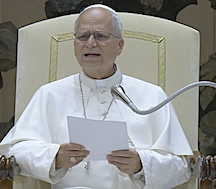
Pope Leo’s Question and Answer the with the youth of the dioceses of Lazio
Paul VI Hall – Saturday, November 21, 2026
FIRST QUESTION
Holiness, my name is Chiara and I am 26 years old.
This morning we met with young people who shared with us their simple and courageous desire to fully live their baptismal calling.
However, it is often difficult to live faith consistently and authentically; we allow uncertainty and doubts to overwhelm us.
Therefore, we ask for suggestions that will help us survive periods of dryness in faith and help our loved ones face difficulties and trials on life’s path.
ANSWER FROM THE HOLY FATHER
First of all, good morning and hello everyone!
It is always a joy to meet you and reflect, starting with your questions.
I would like to begin by referring to what Clare just said: “It is often hard to live by faith.”
Do we all immediately understand the same thing by the word “faith”?
In the Church, “faith” means following Jesus Christ, who is the Son of God, the Savior of the world. Is that difficult?
We can say that sometimes it is.
But it is not as difficult as a mathematical or philosophical task.
Christian faith is above all a bond of friendship with Jesus and a bond of friendship with all whom He Himself called to follow Him – before us, with us, and also after us.
This bond sheds light on the uncertainties we may experience because it invites us to read and reflect on our life in the Gospel.
Then we see that it is the Lord Jesus who cares for His friendship with us,
especially when – on our part – it weakens or weakens.
I give you two suggestions.
First, discover in the Gospel the words and gestures with which Jesus loves us, savoring them day by day on the pages of Scripture;
Second, to go through the Church with brothers and sisters, because from the beginning Jesus wanted to have disciples and form His community with them.
SECOND QUESTION
Holy Father, I am Flavio and I am 20 years old.
On this day, we renew our baptismal promises, to once again accept the call to holiness and change the world.
However, we young people often feel called to “act,” meaning we perceive that we cannot be fragile and always have to prove something to others.
In fact, this seems contradictory to our desire for holiness because we almost feel the need to be perfect.
How can we truly live the desire for holiness, reconcile with our humanity, and remain “incarnate” and “engaged” in the reality we find ourselves in?
ANSWER FROM THE HOLY FATHER
Another good question!
We must say, using your words, that holiness is not an act that stresses us out, nor another expectation to be fulfilled.
On the contrary, holiness is a gift, a calling that corresponds to our deep desire to find happiness, to be happy.
Holiness blossoms and matures in us, following Jesus Christ, without competition with others.
It is He, the Holy One, who sanctifies us, transforming us into His image.
Dear young people,
How loving, how surprising is the God of Jesus, the God who is Jesus!
Being in His company frees us from the burden of counting everything we do and saving ourselves.
Christ saves us, Christ knows us by name, and over time reveals our true name, this authentic identity, this infinite dignity, this place in the world He has provided for us. By following Jesus, we become who we are.
This is the mystery of holiness: you accept Him as a grace, you live Him as a mission.
It is truly an alternative and convincing way of life that gives the world a new face through new faces of those who follow Jesus. Thank you!
THIRD QUESTION
I am Francesca and I am 22 years old.
Many of us are going through important life choices.
As we approach adulthood, the topic of vocation therefore becomes essential to help us understand the path we should follow.
For this reason, first of all, we would like to know how you experienced your vocational discernment.
We also ask you to point out the tools through which we can accept the plan of happiness that God has for us.
ANSWER FROM THE HOLY FATHER
Thank you for this question.
At my age, I can say that God always calls; and discernment is living through conversation with the Lord, sharing experiences and decisions with Him every day.
At your age, this dialogue obviously concerns the questions of every young person:
who to become, with whom to become, with whom, for whom.
In our hearts, some questions may resonate more painfully when it seems we are not ready to face the task or to bear the burden of poverty and injustice that do not depend on us.
The context and time in which we live may discourage us, but the Lord loves us here and now and calls us here and now.
These are important years, the ones you are living through.
And you are living them at an important historical moment.
Among the challenges and promises, threats and hopes of the present, the Risen Jesus walks with us.
In the Church, we find provocation and help.
For example: a challenge to “forever”!
Yes, the Church educates the faithful with choices that last and endure difficulties because God’s love is eternal.
And the help of the Church is realized in people, rhythms, places, spiritual and merciful experiences where we can listen to the living Word that calls us.
I can gladly say that it was similar for me!
FOURTH QUESTION
Holy Father, my name is José and I am 19 years old.
The sacrament of Baptism gives us belonging to the Church:
our faith is born from a deep relationship with the Lord and is fulfilled within the community.
What style of witness can we nurture without risking living by faith as “free beaters,” self-referential, or isolated?
How can we proclaim the beauty of the Church to young people who feel “distant”?
ANSWER FROM THE HOLY FATHER
To answer this question, I will challenge you on two points.
First point: José Francisco told us that faith “is born from a deep relationship with the Lord and is fulfilled in community.”
However, one can say the opposite:
Faith is born in community, meeting believers, and is fulfilled in a deep relationship with the Lord.
Both aspects go hand in hand because faith is neither closed within the community nor within itself but always opens itself to God and others.
For this reason, “going out” was a verb so dear to Pope Francis.
Let us think: every Sunday we gather at the Lord’s table to celebrate the Eucharist, and then we go out and bring His love into daily life.
The second point: provocation is the consequence, and it is this: people far away do not exist! Because God is close to everyone, even those whom we consider – or consider ourselves – far from Him.
God does not reject anyone just because He wants to live with us!
That is why others are our neighbors: neighbors are not chosen, they are everyone whom life places beside us and unites. The Church thus helps avoid a mentality that opposes “us” and “them,” “neighbors” and “distant,” “ours” and “others.”
Because we pray saying “Our Father,” we learn to recognize brother and sister, even those who seem distant or present themselves as opponents.
No one is far from those who have God in their hearts. Thank you!
FIFTH QUESTION
Holiness, I am Maria Teresa and I am 18 years old.
As the theme of the upcoming World Youth Day in Seoul, you chose Jesus’ sentence:
“Donot give yourself strength, I have overcome the world!”
This promise gives us hope and reminds us that He has already triumphed.
He has overcome death, conquered evil, and also overcome our sins.
For this reason, we would like to hear the Lord’s words about how we, young people, can live today in the Sacrament of Confession, a special encounter with Jesus, who continues to encourage us on this path. Thank you.
ANSWERFROM THE HOLY FATHER
Yes, during the Last Supper Jesus says to His disciples: “Youhave tribulations in the world, but take heart: I have overcome the world!” (John 16:33).
John 16:33
I have said this to you, that in me you may have peace.
In the world you have tribulation; but be of good cheer, I have overcome the world.”
By listening to these words, we understand what it means to win and what victory the Lord gives us.
Theway Christ conquered the world has a name and is called salvation.
This victory is not at all confused with the violent attitude of those who win by destroying someone else.
We must carefully reflect on this in this world, a competitive world where a culture of power, challenges, and war poisons every encounter and turns it into a start, a rivalry.
Instead,there is the model of Jesus, it is the life of Jesus: Jesus triumphs on the cross, giving His life for us, freeing us from sin and death. Jesus triumphs because He can see something more than what happened to Him.
Therefore, whenHe is crucified, He says: “Father, forgive them” (Luke 23:34).
This is the conquest of the world: to see it with all its evils and love it, to love it with the love of God, who heals them forever.
This is the work of redemption: through Jesus, God’s mercy melts evil like snow in the sun.
This immense good calls us to having goodness.
So In respect to your question, Maria Teresa, confessionis a sacrament in which we live redemption in a very personal, true way, face to face with the Lord.
That is why we truly go free: free to love as He loved us.