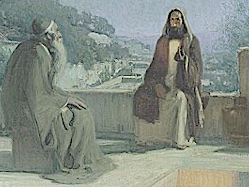
Illustration: Nicodemus Visiting Christ, 1899 painting. Nicodemus (left) talking to Jesus, by Tanner
Pope Leo’s Prayer Vigil with Young People
“Lluís Companys” Olympic Stadium (Barcelona)
Tuesday, 9 June 2026
First of All: Dialogue between Pope Leo and Young People who sought answers to their questions!
Followed by Pope Leo’s personal homily to the Young People at the Prayer Vigil
_________________________________
Dialogue between Pope Leo and Young People who sought answers to their questions!
Holy Father, we grow up hearing that the only goal in life is to be productive, succeed and maintain our image.
I tried to do just that, but I only found an immense emptiness.
So I started to search for answers, my life took a turn, and I was baptized this past Easter.
Since this path is new to me, I would like to ask:
How can we keep our gaze lifted up toward what truly matters, when society pressures us constantly to look at the ground or only at ourselves?
How can we discover our true vocation in the midst of this strong current?
Pope Leo
1. Thank you for sharing your testimony.
First of all, I would like to share in your joy, as well as that of all those who have received the sacrament of Baptism this Easter.
Many young people and adults are rediscovering the Christian faith, after having drifted away from God over time. This is a significant step.
Everything we gradually discover, embrace and experience along the way certainly contributes to our growth and maturity creating space for interior life.
However, amid life’s joys, successes and defeats, we realize that we need a different kind of water to quench our deepest thirst.
Our desire for truth and happiness requires wider horizons.
This restlessness is a gift that God himself gives:
We are made for the infinite, and that is why every finite horizon, every step, every achievement — while satisfying us — also propels us forward.
They invite us to keep searching, to search as we move forward.
They invite us to keep searching as we move forward.
Here, I would like to come back to the question with two brief thoughts.
First, we must cultivate that healthy sense of restlessness.
In our societies, the idolatry of profit and performance, the drive to always produce and win, as well as the cult of self-image, are nothing more than anesthetics designed to numb our conscience and mold it to a certain vision of society.
When people learn to pause and value what is important, appreciate time in a new way and reflect on their own lives while allowing themselves to be enlightened by the Gospel, they also develop a critical perspective on a social system that does not put people first and creates situations of injustice and existential poverty at various levels.
That is why restlessness is frightening, as is the discovery of one’s inner self, of spirituality and, even more so, of the Gospel.
Second, it is in this world that we must cultivate restlessness, not in another.
It is within this society that you and so many others have discovered the value of a more human and fulfilling life, open to encountering God and to the joy of faith.
This means that, despite the difficulties, the place where God makes himself present and where we must find his footprints is always in our current reality.
We believe that the Holy Spirit acts and works silently in all situations of life and history, even the most difficult ones.
However, we must nurture this restlessness and make room for it.
As I said, “look within” and try not to be overwhelmed by the pace of life and external temptations. Cultivate moments of silence, perhaps pausing for a few minutes each day to read the Gospel and speak with God.
Try to walk this inner path together with others, allowing yourselves to be accompanied on the journey and engaging with priests, religious and people who, like us, have set out on this path.
Holy Father, in a world where so many things are shouted from the rooftops, there are aspects of life that remain hidden in silence and shame, such as depression, a silent illness that affects many people — both young and old — and brings with it darkness, isolation and immeasurable pain.
Sometimes, the pain is so overwhelming that the idea of disappearing seems like the only way out.
I myself struggled to overcome this illness in silence for years, and one Friday night I lost the battle and tried to take my own life.
I am here because God gave me a second chance, and I will be eternally grateful to him, but there are many others who continue to face this darkness.
That is why I ask you with all my heart: Where can we see God when the darkness is absolute and we cannot take it anymore?
How can we trust in God when it seems that nothing — not even our own life — is worth it?
Pope Leo
2. First of all, thank you for sharing your experience of suffering with us today.
I am moved that you are able to speak about it, that you are here among us and that you have found the strength to embrace this second chance that the Lord has given you.
You have risen and continued your journey, and this is a remarkable miracle that we see in many Gospel passages.
Through contact with Jesus, even those who feel lost regain confidence in life; healed of their illness, they can rise to live again.
In your question, you first referred to depression as a “silent illness.”
It is important to recognize how mental health is increasingly threatened in the context of societies that consider themselves advanced.
This is a sign that there is something deeply wrong with a certain notion of progress that subjects people to pressures, expectations and tensions that compromise healthy balances.
For this reason, we need a healthcare system that prioritizes this invisible and widespread malaise, which also affects young people.
Your words, however, have also shown us that suffering tests our faith and the meaning we give to life. This is true for everyone, not just for those who at some point face the trial of illness.
As I listened to you, I thought of the hours of darkness, anguish and pain that Jesus experienced as the hour of his death drew near.
The Gospels, in the accounts of the Last Supper and the prayer in Gethsemane, emphasize that evening was falling and that night was coming.
Shortly before his death on the cross, we read that “darkness came over the whole land.”
But, in reality, this was not merely a matter of personal suffering.
The Son of God took all the anguish, loneliness and suffering of humanity upon himself, in his own flesh.
In those dark hours, as he was dying on the cross, Jesus shared our pain and revealed to us the face of a compassionate God, who bears our sorrows, who suffers with us, weeps our tears and remains at our side with his presence full of love and mercy.
Going through this experience is difficult, as Sacred Scripture attests time and again.
There are moments of darkness and suffering that our society silences because certain cultural norms demand that we always be victorious and perfect, and so our limitations, fragility and pain must be eliminated or confined to the deafening silence of loneliness or even shame.
And in these moments, we may instinctively think that God has abandoned us as well.
However, the cross of Jesus tells us that God does not abandon us, that he is at our side, crucified with us in moments of pain and extreme loneliness, that he gathers not only our tears but also the cry of our suffering that others do not hear — a cry that Jesus made his own on the cross, saying, “My God, my God, why have you forsaken me?”
In a catechesis on the final hours of Jesus, Benedict XVI says that his suffering becomes a cry of prayer, and this is true for us as well: in the face of the most difficult and painful situations, when God seems absent, we must entrust to him once again the burdens we carry in our hearts, even crying out to him, even protesting like Job, confident that in some way he is present and near even when he appears to be silent.
But I believe we cannot do this alone. In times of pain, at least as much as possible, we must open ourselves to someone who can help us utter a simple prayer, who can accompany us with discretion without rushing to explain that pain, who can take us by the hand and lead us out of this cry.
These experiences also offer a message to us believers, to the whole Church: we must not spiritualize pain, superficially attributing it to “God’s will” or to some mysterious plan of his, because this risks minimizing that suffering, silencing it and hurting people.
God does not want suffering. He carries it with us and invites us to trust in him with perseverance. Let us remember what Pope Francis said: with God, life is always reborn.
Good evening, Holy Father. I come from a family in a very poor neighborhood of Barcelona.
When I was little, my father tried to kill my mother, and she was saved because a young man stepped in and died instead.
My father went to prison, and my mother turned to drugs.
When I was ten, social services took me in and sent me to the “San José de la Montaña” juvenile detention center.
At first it was difficult because I had built a wall around myself to protect myself by not letting anyone in.
Little by little, I experienced family love for the first time, and my heart began to open up.
There they told me about Jesus; I started to pray and was baptized.
But during my teenage years, I rebelled against God many times.
I was invited to a retreat, and there, for the first time, I experienced God’s love.
But a few months have passed, and I still find it hard to forgive my father.
And sometimes I look up to heaven and ask God, “Where were you when I was a little girl?”
Holy Father, how can I forgive my father for almost leaving me without a mother?
How can I truly be reconciled with God?
Pope Leo
3. Thank you for sharing your testimony and thank you also for your question about forgiveness.
It is truly a sign of God’s grace that you have the courage to ask how to forgive those who have wronged us despite your past suffering. I would like to mention two things.
First, I would like to expand on what I said earlier about God’s presence in our times of suffering.
Deep down, you are also asking this question in relation to your childhood.
However, the context in which the events of your life have unfolded requires us to broaden the scope of our question.
Should we ask “where was God”?
Or should we ask ourselves about humanity, about how we are sometimes prisoners of evil, resorting to violence against others?
How is it that we fail to cultivate love and respect for others’ dignity and freedom?
So many crime reports, even today, reflect a toxic climate in family relationships marked by abuse and oppression and, in particular, by violence against women, which unfortunately often leads to femicide. We are all called to address this dramatic reality, which has anthropological and cultural roots, both personally and as a society, because we are responsible for confronting it in all its dimensions.
We cannot attribute to God what has been entrusted to our responsibility; we cannot imagine that God, from on high, will automatically respond to our needs or miraculously prevent evil from happening.
He has endowed us with intelligence and will, given us a conscience, clothing us in dignity and freedom, and above all has come among us in his Son, Jesus Christ, showing us the path to follow so that our lives may be fully human and so that justice, peace and fraternity may reign in our society.
He has given us his own Spirit, precisely so that love may be the key to all our human relationships.
If violence exists, if selfishness prevails, if even love among family members turns into hatred, we must question the dynamics of our society, the culture of individualism and the temptation of violence — but not God.
The second point concerns forgiveness.
We must learn to view forgiveness — that powerful remedy for evil that heals our inner wounds — as part of a process and a journey.
If we read the Gospel as a book of instructions, commandments and duties, we risk becoming greatly discouraged and frustrated because Jesus invites us to forgive, yet we find ourselves unable to do so.
But that is not the case.
Above all, we must seek forgiveness from the Lord.
We must continually ask the Lord — perhaps for our entire lives — to expand the space of love within us, precisely where we have been wounded, that he can help us reconcile with ourselves and with that part of our past that has been marked by suffering, so that he may slowly transform resentment into mercy and compassion.
This is a long journey and a process that requires great patience.
It is an effort we must make, both on a personal level and through other means of support, as well as inner reconciliation.
We must not lose heart: we move forward in small steps toward forgiveness.
Reconciliation with the past is gradual.
Above all, we must not think that forgiveness always and in every case means returning to the previous situation or having a close relationship with those who have hurt us, especially when there was violence. We can maintain a good disposition of heart toward the person, reject all forms of hatred or revenge, strive to repair the relationship as much as possible and perhaps pray for him or her.
All of this helps us to enter more and more into the dynamic of forgiveness and to be reconciled with God and with others.
We are forgiven sinners; we are at peace, are able to forgive and are able to be peacemakers.
_________________________________
Pope Leo’s personal homily to the Young People at the Prayer Vigil
Pope Leo’s Homily
Like Nicodemus, we too are pilgrims in the night.
This Gospel story (above) offers us a message primarily about the journey of life.
Our journey, our desires and everything we embrace and experience daily — in joys and defeats, in aspirations and plans — are the expression of our ongoing search.
We are beggars for love; we are truly hungry and thirsty.
We seek a deeper meaning that will sustain us, inspire us, and help us understand the mystery of our lives.
As we slowly move forward, one small step at a time, we are called to engage with the shadows of our own human condition: we lack the full truth; we do not fully fathom the mystery of ourselves or the true identity of others; we do not always succeed in understanding the hidden truth of the reality that surrounds us and the events unfolding before our eyes.
We seek a light to illuminate the path.
But Nicodemus also speaks to us about the path of faith.
It is not a path that runs parallel to that of our human existence.
Rather, these two paths are always intertwined.
As we heard in the Gospel, God so loved the world that he gave us his only begotten Son, and in him, united himself forever with our flesh.
He is always with the Father and with us.
Thus, every time the mystery of our life unfolds in the light of a new day, in all that we are and do, we are in God’s presence and held in his eternal embrace: our life “is hidden with Christ in God”.
Yet, at times we experience the night of faith, the weariness of believing, the fatigue of the spirit, a sense of inadequacy in the face of the Gospel’s call, the bitterness of our failures and the fear of not measuring up.
Brothers and sisters,
Nicodemus teaches us that these nights — which accompany our lives, our journey of faith, and the history in which we live — are a time of blessing, a place for rebirth, a womb that always gives birth to new life.
These nights strip us bare and return us to what is essential.
They remove the human and religious masks we wear by day to keep ourselves from being recognized or to present ourselves differently than we are.
They expose us, revealing our lights and our shadows.
These nights restore us to the humility of knowing how to look at ourselves in truth, beyond the presumption of thinking that our journey is already complete and that we move forward as if we had a clear understanding of everything, everyone and even God.
The “empty space” that night creates, even when it takes the form of suffering or dissatisfaction, of disillusionment or unbelief, can be an opportunity to receive new life, to change and be renewed, to be “born again from above,” as Jesus tells Nicodemus.
In fact, God did not come to judge the world in its sin and the night of its unfaithfulness, but sent his Son to save it, to give the world eternal life.
For this reason, we too are called not to judge the “nights” — neither the nights of our own lives, those of the Church, nor those of the society around us.
In the night, we must instead set out on a journey as Nicodemus did, continuing to ask questions of the Lord and open ourselves to the wind of the Spirit.
We must welcome the night no longer as a sign of failure, but as the beginning of a new life.
And as we reflect on our personal journey, as well as on the “nights” of our journey as a Church and those of Spain — in its cities, its old and new forms of poverty, its society and culture — we may well ask ourselves: What are the “nights” we are passing through?
What do they say to us?
As we enter into them and humbly look, without prejudice, at the reality of who we are, what are we called to change?
Where must we seek renewal?
What direction do we want to take?
What kind of society do we want to build?
Even in the heart of night, we must not give up searching, questioning and dialoguing with God and with each other.
Let us walk together in the faith that harmonizes the diversity of our ideas and sensibilities in order to seek the truth that will guide us toward the common good.
This country may then be a welcoming space for all, where each person’s dignity is respected and everyone loved for who they are.
Let us open ourselves to the gift of the Spirit, seeking the Lord like Nicodemus, and welcoming the light of his Gospel with the certainty that we will experience a new life within us, a presence that blesses, a gratuitous love that will help us pass from night into light.
For God does not want anything to be lost, and even now he desires to give us eternal life and lead us to a happiness that has no end.
Through the intercession of the Virgin Mary, may the Lord grant us the grace to open ourselves to him and to be shaken by the wind of his Spirit.
Scripture Reading on Nicodemus from the Gospel of John 3:1-21 and John 19:38-42
John 3:1-21
Now there was a man of the Pharisees, named Nicodemus, a ruler of the Jews. This man came to Jesusby night and said to him, “Rabbi, we know that you are a teacher come from God; for no one can do these signs that you do, unless God is with him.” Jesus answered him, “Truly, truly, I say to you, unless one is born anew, he cannot see the kingdom of God.”Nicodemus said to him, “How can a man be born when he is old? Can he enter a second time into his mother’s womb and be born?” Jesus answered, “Truly, truly, I say to you, unless one is born of water and the Spirit, he cannot enter the kingdom of God. That which is born of the flesh is flesh, and that which is born of the Spirit is spirit. Do not marvel that I said to you, ‘You must be born anew.’ The windblows where it wills, and you hear the sound of it, but you do not know whence it comes or whither it goes; so it is with everyone who is born of the Spirit.” Nicodemus said to him, “How can this be?” Jesus answered him, “Are you a teacher of Israel, and yet you do not understand this? Truly, truly, I say to you, we speak of what we know, and bear witness to what we have seen; but you do not receive our testimony. If I have told you earthly things and you do not believe, how can you believe if I tell you heavenly things? No one has ascended into heaven but he who descended from heaven, the Son of man.
And as Moses lifted up the serpent in the wilderness, so must the son of man be lifted up,that whoever believes in him may have eternal life.” For God so loved the world that he gave his only Son, that whoever believes in him should not perish but have eternal life. For God sent the Son into the world, not to condemn the world, but that the world might be saved through him. He who believes in him is not condemned; he who does not believe is condemned already, because he has not believed in the name of the only Son of God. And this is the judgment, that the light has come into the world, and men loved darkness rather than light, because their deeds were evil. For everyone who does evil hates the light, and does not come to the light, lest his deeds should be exposed. But he who does what is true comes to the light, that it may be clearly seen that his deeds have been wrought in God.
John 19:38-42
Behind the death of Jesus, Joseph of Arimathea, who was a disciple of Jesus, but secretly, for fear of the Jews, asked Pilate that he might take away the body of Jesus, and Pilate gave him leave. So he came and took away his body. Nicodemus also, who had at first come to him by night, came bringing a mixture of myrrh and aloes, about a hundred pounds’ weight. They took the body of Jesus, and bound it in linen cloths with the spices, as is the burial custom of the Jews.Now in the place where he was crucified there was a garden, and in the garden a new tomb where no one had ever been laid. So because of the Jewish day of Preparation, as the tomb was close at hand, they laid Jesus there.