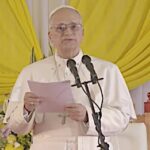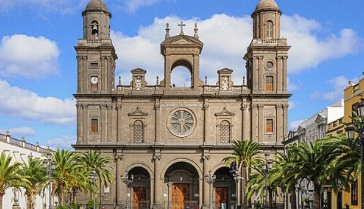
Illustration:Cathedral-Basilica of Canary is located in Las Palmas, Canary Islands.
Pope Leo’s address to encountering the realities of migrants
Port of Arguineguín (Las Palmas de Gran Canaria) – Thursday, June 11, 2026
Gospel Reading: Matthew 25:41-45
41 Then he will say to those at his left hand, ‘Depart from me, you cursed, into the eternal fire prepared for the devil and his angels; 42 for I was hungry and you gave me no food, I was thirsty and you gave me no drink, 43 I was a stranger and you did not welcome me, naked and you did not clothe me, sick and in prison and you did not visit me.’
44 Then they also will answer, ‘Lord, when did we see thee hungry or thirsty or a stranger or naked or sick or in prison, and did not minister to thee?’ 45 Then he will answer them, ‘Truly, I say to you, as you did it not to one of the least of these, you did it not to me.’
_______________________________
Pope Leo’s address
Dear Brothers and Sisters,
We have just heard one of the most demanding pages of the Gospel.
We know that this same chapter also makes a warning that no believer can take lightly
Today, by the sea, the Word becomes concrete.
So many wounded lives arrive here, stripped of almost everything, but never of their dignity.
Here the Gospel pulls us away from our comfortable position as spectators and places us before our brothers and sisters who have arrived.
It asks us if we have recognized Christ in those disembarking, marked by fear, hunger, and violence after the desert, night, and sea.
As you can see, I am wearing the ring called the “Fisherman’s Ring.”
Its name itself leads us to the Sea of Galilee, where Christ called Peter and said: “From now on, you will be fishers of men” (Luke 5:10).
The Church interprets this verse as a metaphor for its mission.
However, in places like El Hierro, this mandate takes on a literal and painful meaning. This small island, great in humanity, has seen thousands of people arrive, torn from their land and entrusted to the fragility of a canoe.
Here, people have been rescued from the sea, and lifeless bodies have been pulled from the water. For this reason, the Successor of Peter cannot ignore these docks.
The Church cannot ignore these waters or any place where hunger, thirst, violence, fear, or exile continue to wound human dignity.
The disciples of Jesus cannot consider the cries of those who cry out from the night as foreign.
In biblical language, the sea can represent threat, darkness, and chaos.
The Leviathan, a figure of devouring power, and Rahab, a name evoking pride in rising up against God and life, appear.
(Psalm 74:13-14 –By his power he stilled the sea; by his understanding he smote Rahab).
(Psalm 89:10-11; – Thou didst divide the sea by thy might; thou didst break the heads of the dragons on the waters. 14 Thou didst crush the heads of Leviathan, thou didst give him as food[a] for the creatures of the wilderness).
(Isaiah 27:1 –In that day the Lord with his hard and great and strong sword will punish Leviathan the fleeing serpent, Levi′athan the twisting serpent, and he will slay the dragon that is in the sea).
(Isaiah 51:9; Awake, awake, put on strength, O arm of the Lord; awake, as in days of old, the generations of long ago. Was it not thou that didst cut Rahab in pieces, that didst pierce the dragon?)
Job 26:12 – By his power he stilled the sea; by his understanding he smote Rahab).
Even today there are monsters that stalk these seas: mafias that traffic in desperation, traffickers who enslave women and children and the indifferent who allow the poor to be swallowed up by exploitation or oblivion.
But faith is not paralyzed by the power of the sea.
We believe in a God who conqueres chaos, restricts evil and paves the way when death seems inevitable.
This is what the people of Israel experienced when they crossed the Red Sea, leaving slavery behind and walking towards freedom.
And so we contemplate Christ, who walked on water and, in the face of the storm, spoke a powerful word: “Be silent!” (Mark 4:39; cf. Matthew 14:25-27).
That voice continues to resonate against the forces that devour, enslave and discard so many of our brothers and sisters.
Just as Christ commanded the sea to be silent, the Church cannot remain silent in the face of those abandoned to her care.
Thank you for sharing your stories and reminding us what it means to save lives.
Thank you, Mary, for reminding us of the work of Caritas, the parishes, and so many others every day. The words show us where the conversion of the gaze begins:
When the migrant ceases to be “just another one,” he ceases to be a category and a number. Only then do we realize that this girl could be our daughter and that those faces could be part of our family. At that point, our conscience runs out of excuses.
Mercy begins with small gestures.
Sometimes with a few cookies and a little milk.
Other times, it’s five loaves and two fishes.
Solving everything is not the point.
Rather, it is a matter of entrusting everything to God and being present where people suffer, where resources are scarce, and where there is no common language. Yet, even in these circumstances, gestures can still speak volumes.
I warmly thank all those who participate in rescues, welcoming, and accompaniment. They bear witness that concrete mercy can save and change lives.
Dear Blessing,
Although you are not here today, your voice is.
Thank you for sharing your story with us.
Your name means “blessing,” and it reminds us that every human life is a blessing from God.
No one can buy, sell, use, or discard a life because each person reflects the image of the Creator (cf. Genesis 1:27 – God created man in his own image, in the image of God he created him; male and female he created them).
You told us that you left your country not because you wanted to, but because you had no other choice.
In your words, we hear the stories of the many people who have been forced to leave because of poverty, war, threats, or exploitation.
I hope this message reaches you and many other women who are victims of trafficking and exploitation.
If others have put a price on your body, know that God has never seen you as anything less than invaluable.
If they want to imprison you in a past of pain, God continues to make a promise for your future.
If you were treated as a thing, the Church wants to tell you today that you are a daughter and a sister; you are a blessing.
Your life does not belong to those who harmed you, your body does not belong to those who took advantage of you, and your days do not belong to those who tried to chain you to fear.
Your life belongs to God, and you have an inherent dignity that cannot be taken away.
We want to walk with you until you feel that truth stronger than the pain again.
Dear migrants,
Before I say anything else, I would like to acknowledge your dignity. You are not just numbers or files.
You are people who have left behind families and homes; you have dreams that no one has the right to despise.
However, I also want to tell you that your lives must be protected.
Do not surrender your lives to those who trade in them.
Do not believe those who promise easy paradises in exchange for your body, money, silence, or freedom.
These false promises are “siren songs”; they are industries of death.
This drama must serve as an examination of the conscience.
– for the nations of origin, which must create conditions of peace, justice and development;
– for transit nations, called to protect and not to leave the weak in the hands of criminal networks;
– for Europe, which cannot proclaim human dignity and get used to the Mediterranean and the Atlantic being cemeteries without tombstones;
– for the international community, called to effective and persevering cooperation.
The Church must also allow itself to be challenged.
Receiving migrants cannot be secondary or delegated only to a few volunteers.
We kneel before the altar to adore Christ, who is present in the Eucharist.
From him, we receive the strength and motivation to live a life of charity.
For this reason, we cannot simply “pass by” the cayucos and pateras.
From prayer springs all service, and to it all commitment returns.
(Luke 10:31-32 – by chance a priest was going down that road; and when he saw him he passed by on the other side. 32 So likewise a Levite, when he came to the place and saw him, passed by on the other side.).
From this island, I would like the voices of those who spoke today to reach those who hold decisive responsibilities: civil authorities, parliaments, governments, and international organizations, as well as Christian communities, other religious traditions, and all people of goodwill.
Managing arrivals, distributing figures, reinforcing borders, and lamenting deaths after they have occurred is not enough.
Every boat that arrives does not only carry migrants.
It raises the question: What kind of world have we built if so many of our brothers and sisters must risk death to seek life?
Human dignity requires legal and safe channels, rescue and assistance, cooperation to combat human trafficking, effective protection of victims, serious reception and integration processes, and policies that enable people to live with dignity in their own countries.
While there is a right to seek refuge when life is threatened, there is also a right not to migrate.
This means the right to remain in one’s own home without experiencing hunger, war, persecution, violence, an uninhabitable environment, corruption stealing the bread of the poor, or weapons destroying the future of children.
We can’t get used to counting the dead.
Human dignity does not have a passport nor does it lose value when crossing a border.
May the God who “in the twilight of life will judge us on love” (cf. St. John of the Cross, Warnings and Sentences, 57) help us recognize him in the poor and strangers today.
May he free us from viewing the suffering of others as if it did not concern us.
May Our Lady of Mount Carmel accompany those who have arrived, console those who have lost their loved ones, sustain those who welcome them and awaken the courage of mercy in all of us.
That history will not accuse us of turning the pain of those who suffer into a common landscape on our coasts.
Today, here by the sea, every life that arrives asks us what remains of our humanity.
Sooner or later, we will find out if we knew how to protect it or if we let indifference speak for us.
Thank you very much.