Pope Leo’s greeting to the “Borgo Laudato Si’ Dialogues”
Consistory Hall – Friday, 19 June 2026
Borgo Laudato Si’ is a laboratory of integral ecology where faith, the environment, and education intertwine
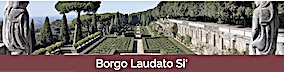
Thanks to the creation of the «Borgo Laudato si’» project, the beauty of the Pontifical Villas’ Gardens has become the natural setting for the development of a place, open to all people of good will, for trained in integral ecology. By setting up Borgo Laudato Si’ in his residence at Castel Gandolfo, Pope Francis wanted to demonstrate that the principles described in the Encyclical «Laudato Si’» could become a reality. The project has been developed in three directions: integral ecology education, circular and generative economy, and environmental sustainability.
“Praise be to you in the village”
Dear brothers and sisters,
You have just concluded two days of intense work at ‘Borgo Laudato Si’ in Castel Gandolfo.
You have gathered to participate in the first edition of the “Borgo Dialogues,”- as Cardinal Baggio was just explaining – which is the first step of a process aimed at renewing and reimagining moral leadership in a fractured world that has forgotten its historical roots.
You have discussed relevant issues, that are also concerns of the Catholic Church: such as artificial intelligence and its relation to humanity, aging and vitality, sports, diplomacy and the future of sustainability.
In doing so, you have fulfilled the desire I recently expressed in my encyclical letter, Magnifica Humanitas.
“To engage in dialogue with all men and women of our time with whom we share the events, questions, and aspirations of humanity. Together with them, we seek to identify new paths for the common good and for promoting a dignified life for all.”.
As I stated in this document, “We live in an era of significant spiritual and cultural blindness.
A false pragmatism urges us to sever the roots of our history as if it were possible to create something new and entirely separate from the past. Even those who cite important moral principles can fall into this historical nihilism by mistakenly believing that the atrocities of the 20th century can never happen again.”
Your dialogues are based on the Catholic Church’s vision of synodality: listening from the ground up while fostering global unity.
As experts, leaders, and practitioners from different parts of the world and different fields, you have a variety of expertise, experiences, and visions.
Despite this diversity, you are all deeply committed to the world’s ecological, social, and economic transformation.
Faced with the temptation to build the “Tower of Babel,” which symbolizes idolatry and the exploitation of the most vulnerable for the sake of profit, we are called to contribute to the construction of the New Jerusalem: a civilization of love where love is the guiding principle of economic, political, and cultural life.
“The civilization of love will not arise from a single, spectacular gesture. Rather, it will arise from the sum total of small, steadfast acts of fidelity that serve as a bulwark against dehumanization. For this reason, it is worthwhile to pause and reflect on how we can each contribute to building the civilization of love.” (Magnifica Humanitas, 213)
You have done this in the wonderful environment of the Borgo Laudato Si’ Pontifical Gardens, letting the beauty of creation—and of the Creator—inspire you to connect local knowledge with global responsibility.
You have advanced a process aimed at developing courageous leadership, which is much needed today.
Thank you for your openness and willingness to participate in this process. It will bring you together again in other important contexts and open paths for further progress.
May the Lord bless your efforts and grant you the grace to be humble builders of the New Jerusalem, the city of God.
This city offers living water to the thirsty and provides care, recognition, kind words, and tender hands to every human being.
Thank you very much